CR-39, or allyl diglycol carbonate (ADC), is a plastic polymer commonly used in the manufacture of eyeglass lenses. It should not be confused with polycarbonate, a homopolymer made from bis-phenol A, a tough polymer widely used for glazing. CR-39 is a trade marked product of PPG Industries, originally developed by Columbia Chemical Co Inc which evolved through acquisition into the Chemical Division of PPG Industries. An alternative use includes a purified version that is used to measure neutron radiation, a type of ionizing radiation, in neutron dosimetry.

The CR stands for Columbia Resin. During WWII uncured CR-39 Resin was used to coat aircraft fuel tanks. The CR-39 would "self heal" the tanks when struck by flak. The trade name for the original and most popular plastic material used for eyeglass lenses. The abbreviation stands for “Columbia Resin #39,” because it was the 39th formula of a thermosetting plastic developed by the Columbia Resins project of PPG Industries back in 1940. The first commercial use of CR-39 monomer was to help create lighter, more durable fuel tanks for the B-17 bomber aircraft in World War II. After the War, the Armorlite Lens Company in California is credited with manufacturing the first CR-39 eyeglass lenses in 1947. CR-39 plastic has an index of refraction of 1.498 and an Abbe number of 58.
Applications
CR-39 is transparent in visible spectrum and is almost completely opaque in the ultraviolet range. It has high abrasion resistance, in fact the highest abrasion/scratch resistance of any uncoated optical plastic. CR-39 is about half the weight of glass with an index of refraction only slightly lower than that of crown glass, and its high Abbe number yields low chromatic aberration, altogether making it an advantageous material for eyeglasses and sunglasses. A wide range of colors can be achieved by dyeing of the surface or the bulk of the material. CR-39 is also resistant to most of solvents and other chemicals, to gamma radiation, to aging, and to material fatigue. It can withstand the small hot sparks from welding, something glass cannot do. It can be used continuously in temperatures up to 100 °C and up to one hour in 130 °C.
In the radiation detection application, raw CR-39 material is exposed to proton recoils caused by incident neutrons. The proton recoils cause ion tracks, which are enlarged by an etching process in a caustic solution of sodium hydroxide. The enlarged ion tracks are counted under a microscope (commonly 200x), and the number of ion tracks is proportional to the amount of incident neutron radiation.
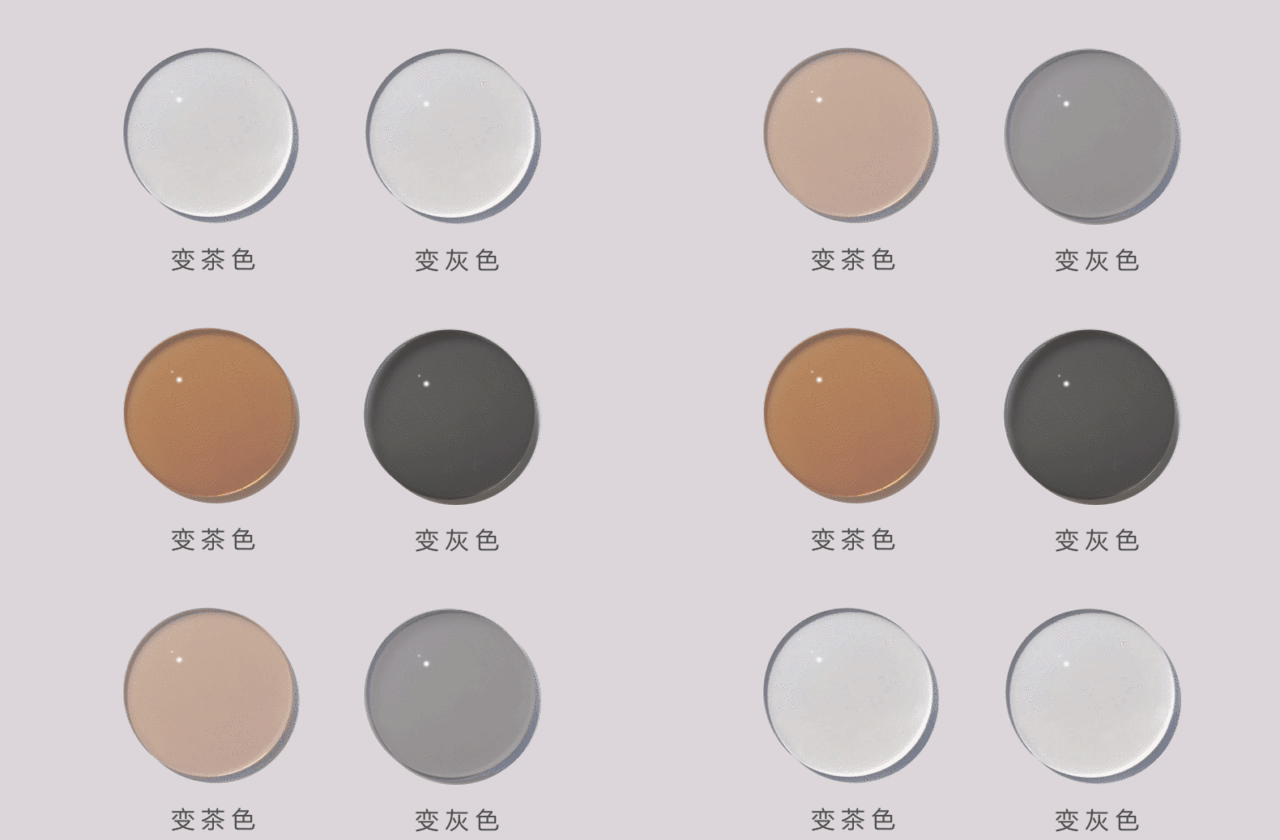
What is the difference between resin lenses and glass lenses?
In terms of characteristics:
The hardness of glass lens is very strong, and it can be heated to more than 300 degrees when scrubbing, while for resin lens, it can only be heated to about 80 degrees, so glass lens has strong heat resistance performance. However, the glass lens is easy to break and the weight is relatively heavy, while the resin lens is different. However, because the resin lens does not have super heat resistance, the lens is relatively soft and is easily scratched by foreign objects.
Functionally:
Resin lenses have the function of 100% UV protection from the sun, preventing the eyes from being damaged by various harmful rays, while glass lenses do not have the function of UV protection, and the optical transmittance of resin lenses is more than 2% higher than that of glass lenses. However, for patients with high myopia, resin lenses are thicker, so they will not be so beautiful to wear.
Although today's resin lenses have been greatly improved, they are much thicker than glass lenses. Therefore, in terms of high temperature resistance, glass lenses have a significantly better lifespan.
What is the difference between resin lenses and glass lenses? Both resin lenses and glass lenses have their own advantages, but I personally think that resin lenses are lighter in weight and less stress on the bridge of the nose than glass lenses. And the impact resistance is also relatively good, when it is impacted by the outside world, it will not be easily broken, which can protect the health and safety of eyes and vision to the greatest extent. Therefore, resin lenses are more suitable for children and myopia patients with relatively large diopter than glass lens optical lenses.
Common sense of lens material: -- eResearch by Navid Ajamin -- winter 2010
1. Material: PMMA: Acrylic (commonly known as plexiglass), which is cheap and heavy, and the phase clarity of the object is average. The lens is easily broken by external force.
PC: commonly known as space film Advantages: light lens (specific gravity is 1.20g/cm³), high strength, high impact resistance, not easy to split, better clarity than PMMA but inferior to CR-39, generally used for sports glasses and protective glasses; when the thickness of the material reaches When it is 2.5cm, it can be used as bulletproof glass; PC sheet can absorb (or block) almost all ultraviolet rays harmful to human eyes, which is especially suitable for drivers and computer operators.
Disadvantages: 1. It is easy to be scratched and the wear resistance reaches B. All PC sheets must be hard-coated to improve the surface hardness of the focusing lens.
2. The lens has a large chromatic aberration
PL (CABTAC): Commonly known as Poly Lay film, it is a mainstream product in the future market. It is light and effective against harmful light and reflected light. It can see objects with high definition and realism. The original film will not be broken but easily scratched. It is generally used for outdoor fishing. , and students wear all fishing goggles and student goggles in class.
CR-39: commonly known as high-grade resin sheet, it is a high-definition lens, expensive and light (specific gravity is 1.32g/cm³)
Advantages: strong impact resistance, high temperature resistance, 10 times higher than glass, so the lens is not easy to break, and the break is not sharp after breaking; the lens is light in weight; the absorption function of ultraviolet rays is better than that of ordinary optical glass sheets
Disadvantages: The sheet is easy to be scratched, and the requirements for the assembled frame aspherical mirror are high. The resin sheet should preferably be coated with an anti-reflection film to improve the light transmittance of the lens.
Older reading glasses should also be replaced regularly. Presbyopia is caused by the aging of the lens. With the increase of human age, the degree of aging of the lens will increase, and the required correction of the lens power must increase accordingly to meet the needs of the elderly in daily life.
There is no unified regulation on the specific replacement time. When the elderly wear glasses to read newspapers and feel tired and their eyes are sore and uncomfortable, they should be replaced.
There are many lens materials on the market today. Resin lenses are light and easy to carry, but they are easily scratched, so pay special attention to lens care. Glass lenses are cheap, but fragile, and if they are broken, they may cause extremely serious damage to the eyeballs, so they are not suitable for teenagers who exercise a lot.
Polycarbonate (PC)
- Organic material with very high breaking strength
- Inherently soft allowing it to absorb impacts, ideal for safety eyewear
- Mechanical strength class "F" (45 m/sec)
- About 20-25% thinner than plastic or glass lenses
- Requires scratch-resistant coating for durability
- Only limited resistance to chemicals and therefore not suited in combination with frameless safety spectacles
CR39 (Plastic)
- Lightweight organic material
- Very good optical performance even for high prescriptions
- Suitable for working with chemicals and paints / varnishes
- Mechanical strength class "S" (falling ball test)
- Good scratch resistance due to hard layer (optional)
- The middle of the lens should always be thicker in order to meet the requirements for tensile strength
Reference:
- en.wikipedia.org/wiki/CR-39
- uvex-safety.co.uk/en/cr39-versus-polycarbonate-lenses
- edlensxs.com/blogs/industry-news/what-is-the-difference-between-resin-lenses-and-glass-lenses
See Also:
- ophthalmic Lens material and design
- eyewear - Comparing Polycarbonate Lenses With Standard CR39 Lenses
 وبلاگ تخصصی عینک شامل مجموعه مطالب پزشکی است که اطلاعات مفیدی در رابطه با عینک , چشم، لنز، سلامتی چشم و راه های پیشگیری از بیماریهای چشمی، کنترل و درمان آن را در اختیار شما کاربر محترم می گزارد.
