ابزار وبمستر

Night Vision Problems as a Side Effect of LASIK

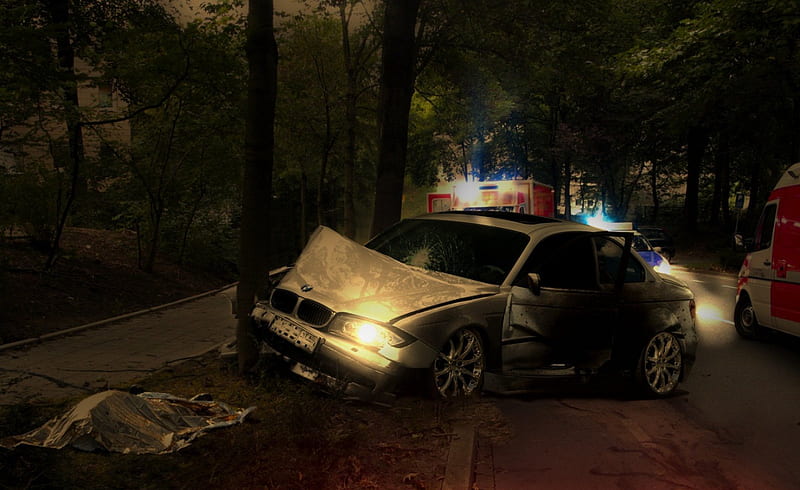
Fatigue, lack of light, compromised night vision, rush hour and impaired drivers all contribute to making driving at night more dangerous than during any other time of day. In fact, the risk of a fatal crash is three times greater at night, according to National Safety Council research.

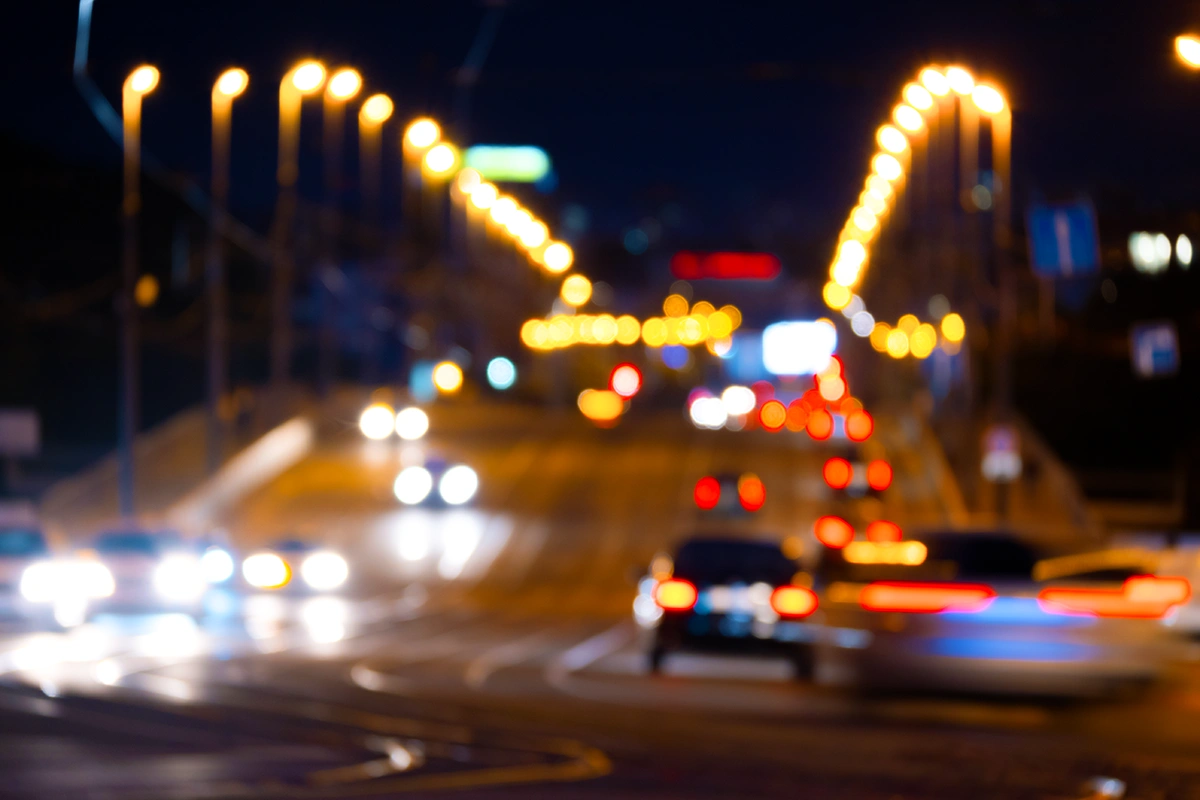
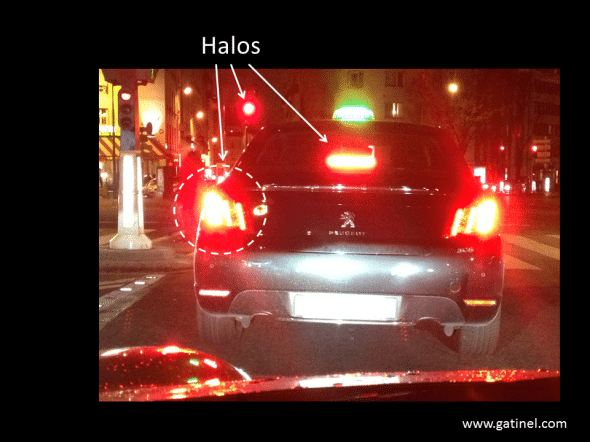
Common night vision problems that sometimes develop after having Lasik include glare, halos, and starbursts, which can make driving at night difficult. For some people, these can become long-term problems after surgery.
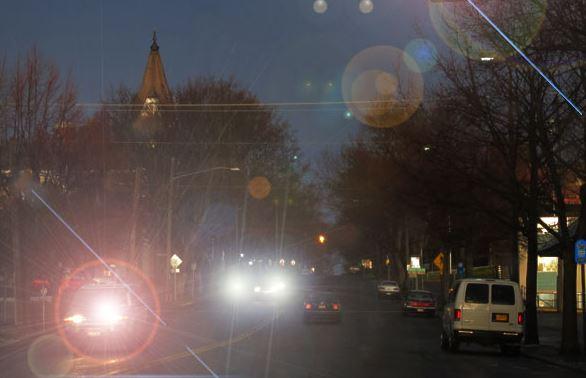
Image result for lasik night vision halos

Night vision is the ability to see in low light conditions. Whether by biological or technological means, night vision is made possible by a combination of two approaches: sufficient spectral range, and sufficient intensity range. Humans have poor night vision compared to many animals, in part because the human eye lacks a tapetum lucidum.[1]

The tapetum lucidum is a biologic reflector system that is a common feature in the eyes of vertebrates. It normally functions to provide the light-sensitive retinal cells with a second opportunity for photon-photoreceptor stimulation, thereby enhancing visual sensitivity at low light levels.
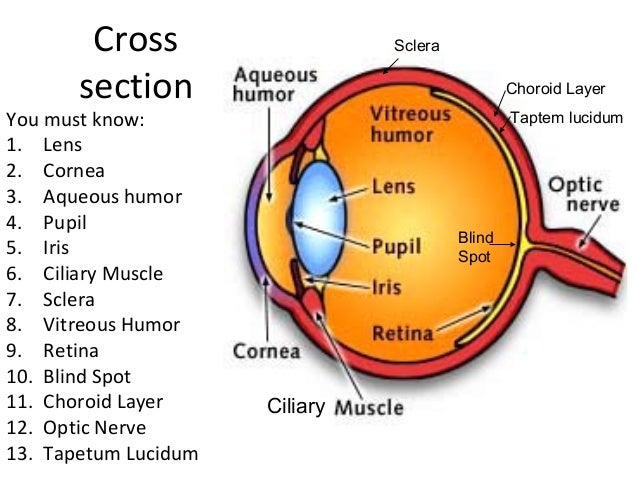
Image result for tapetum lucidum

Causes of Night Vision Problems After Lasik

Glare, halos, starbursts and difficulty seeing in dim light are common problems after having Lasik due to swelling of the cornea. Some night vision problems persist past the recovery period, however, and may be due to the following:

Residual refractive error: This refers to remaining refractive error including myopia, hyperopia or astigmatism. Refractive error may be caused by an over- or under-response of your cornea to the procedure, causing your eyes to either over- or under-correct your refractive error.

Enlarged pupils: Sometimes after Lasik your pupil dilates to a size that is larger than the actual treatment zone, causing persistent night vision problems. The pupil sometimes becomes so large that light passes into the eye and causes glare and halos. Because the pupil naturally becomes larger in the dark, the effects are more noticeable at night.
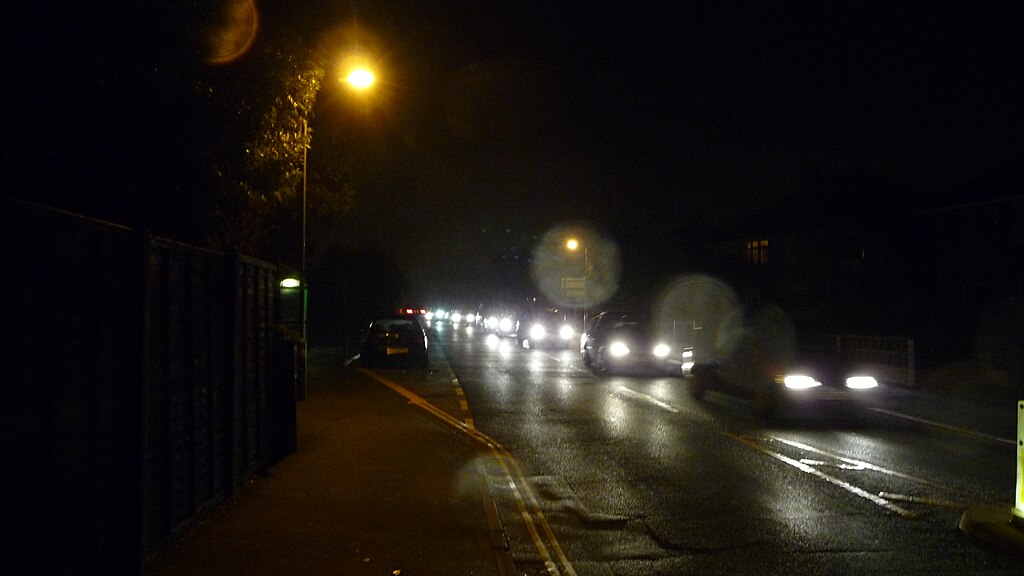
Image result for night vision problems

Corneal flap problems: Sometimes the corneal flap produced by the laser does not adhere correctly to the eye after it is replaced. There are cases where it will not be centered perfectly on the eye. These problems can cause light to bend irregularly at the point where the treated and untreated cornea meet, causing night vision problems.
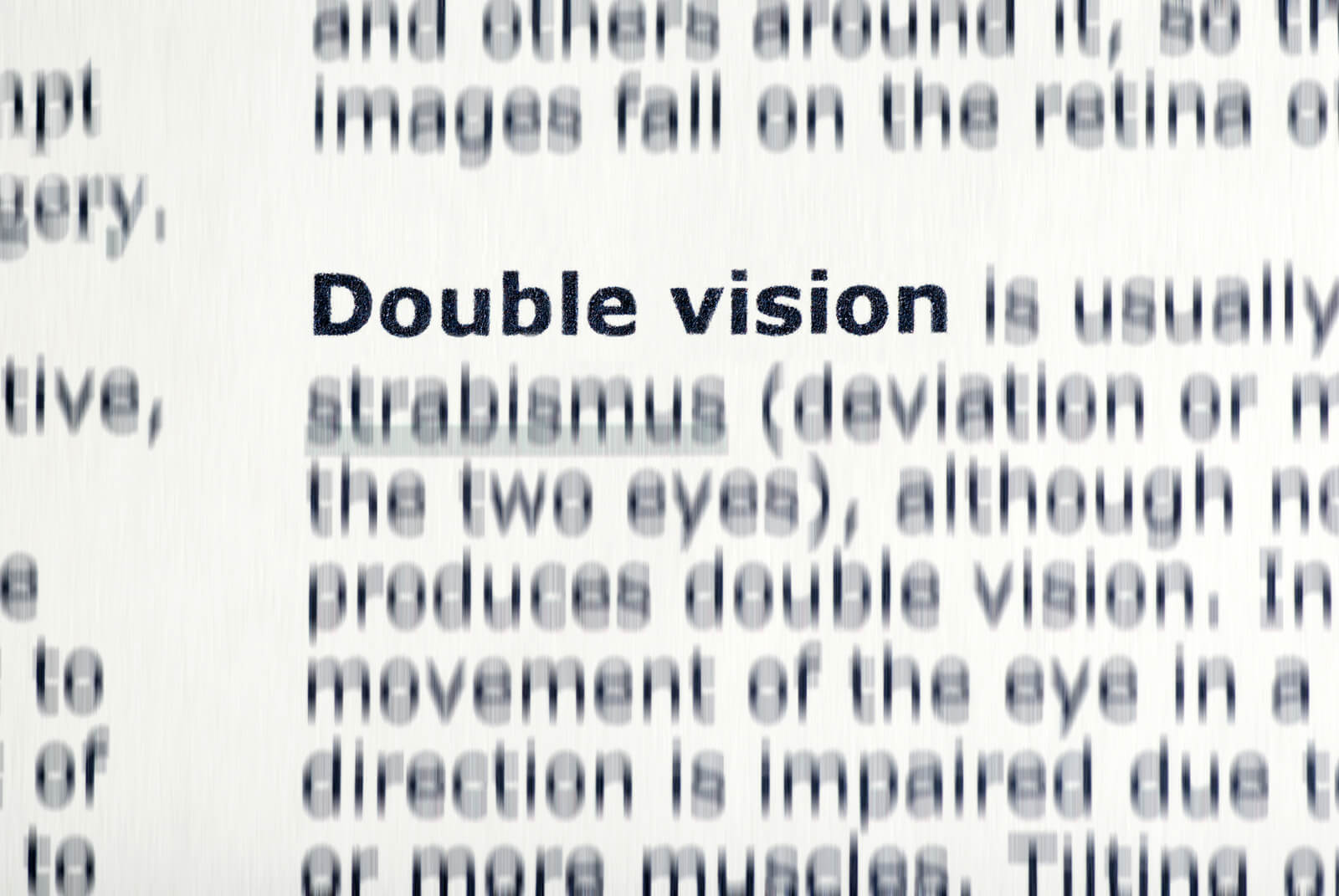
LASIK, PRK, and other forms of refractive surgery sometimes cause double vision. When the corneas are altered, it may initially cause light rays to scatter instead of focusing properly. Fortunately, this issue usually clears up on its own within a few weeks or months.[10]

Decentered ablations: A decentered ablation occurs when the laser treatment is not perfectly centered over the pupil. Decentered ablations occur infrequently, as newer lasers contain advanced eye tracking systems. While decentered ablations do not produce a detrimental effect during the day, they occasionally result in night vision problems.[2]

Night vision problems / disturbances (NVD) is a hot topic of refractive surgery. It will always be a hot topic, and will never be fully resolved (due to the inherent problems of how much tissue can be safely vaporized, and the distortions created when tissue is vaporized). When we talk about night vision, what we are actually talking about is visual distortions in dim light or artificially lit (not specifically very dark) environments.

Related image

some basic terminology :

Photopic – Vision in bright daylight
Mesopic – Vision in artifical light, down to quite dim light (like in a movie theatre)
Scotopic – Vision in no lighting – A moonless night outdoors in the countryside , with only starlight to see by (pretty dark!)

Image result for pupil sizes

Your pupils will be very small in photopic light, bigger in mesopic light and largest in scotopic light. As your pupil expands, more light comes in. Like the arperture of a camera, it allows more light in, so that you can see better in these different environments. Maximum pupil size varies from person to person.

The laser however, can only safely create an optical zone up to 6.5mm, this is due to limitations in how much tissue can be ablated (vaporized) safely.

Above 6.5mm, they create a blend zone which is not a fully corrected area, but acts to smooth out the surface.

Night vision disturbances generally occur when the optical zone created is less than the size of scotopic pupil size. Now there is a caveat, there is something called the effective optical zone and target optical zone. The surgeon may target you for a 6.5mm optical zone, but you could easily end up with a 4mm effective optical zone. This is because the laser loses power on the periphery of the cornea (the outer bit), and it therefore does not recieve the amount of treatment it should have recieved. This results in a smaller optical zone than intended, meaning that even people with 6.5mm scotopic pupils, can end up with night vision disturbances (there are other reasons that result in small optical zones also).

Wavefront ablations attempt to compensate for this, but it generally doesnt work that well, which is why so many people who have had wavefront have night vision disturbances also. eResearch by Navid Ajamin -- spring 2017

Small optical zones are also referered to as something called spherical aberration, and is what generally causes distorted vision, mostly in very dim light (when the pupil is large), but for many with severe spherical aberration it will affect them in anything other than photopic environments.

If you have a scotopic (maximum size) pupils larger than the target optical zone of the laser, you will have a 100% chance of having worse quality vision, and will to some varying extent suffer from halo / glare, starbursting and ghosting.

Distortions can be defined as (but not limited to)

  1. Halo
  2. Starburst
  3. Glare
  4. Ghosting (multi-focal vision)
  5. Poor contrast sensitivity

Image result for multifocal vision ghosting
These distortions can be debilitating, and cannot be corrected with standard contact lenses or glasses.

What is rainbow glare?

Rainbow glare is a rare side effect of femtosecond optical LASIK. It was first described in 2008 by Krueger and al. It affects has very few percentage of the patients that benefit from femtosecond LASIK technology to become spectacle and contact lens independent.

Rainbow glare is usually transient, but may take some months to disappear. In some rare cases, it leads to persistent and disturbing visual symptoms, on which this page will focus.

Femtosecond laser technology to create the corneal flap (which is specific to the technical LASIK) was introduced about 15 years ago. It has progressively replaced the conventional microkeratome (blade cut of the flap) in the hands of most high volume refractive surgeons.

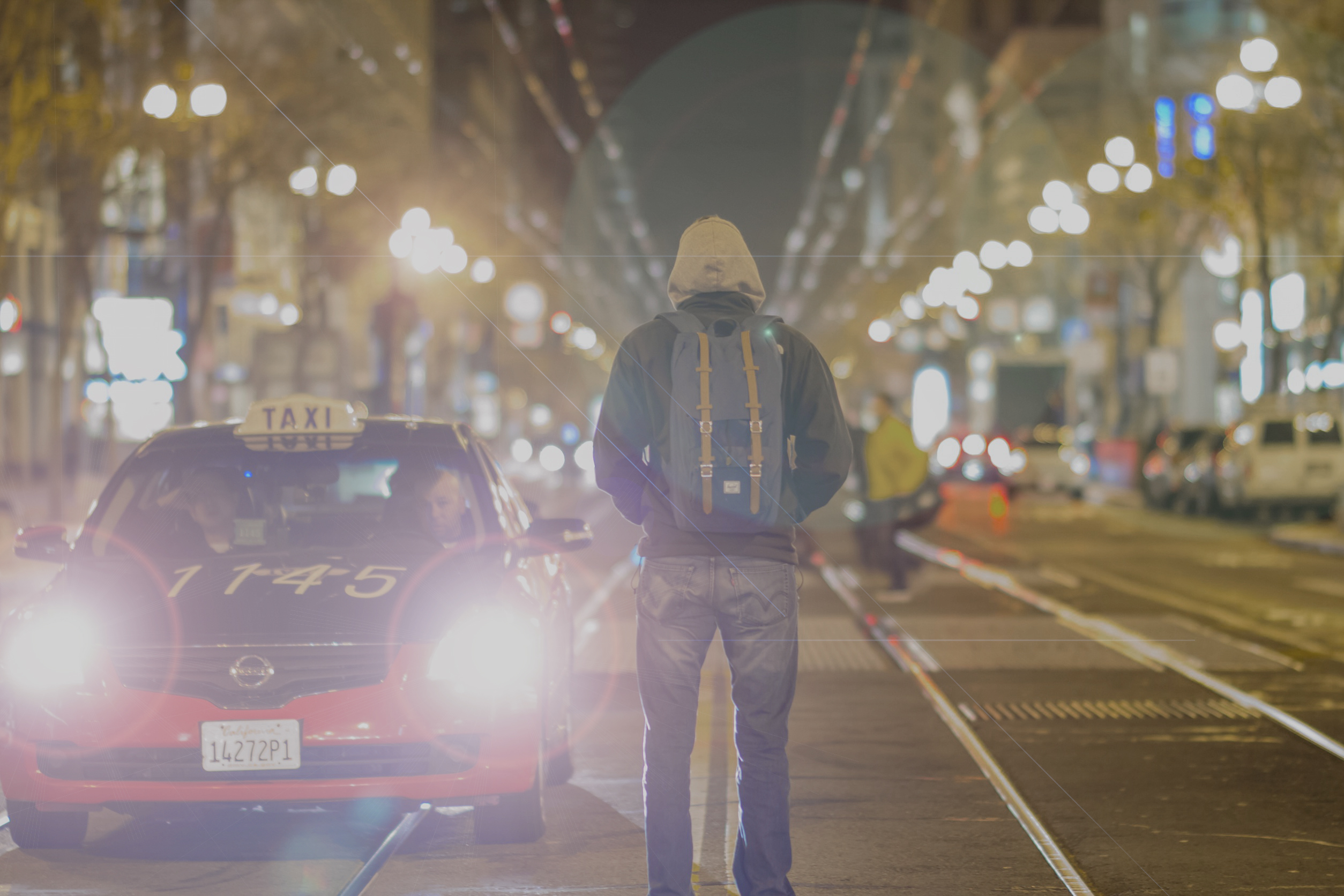
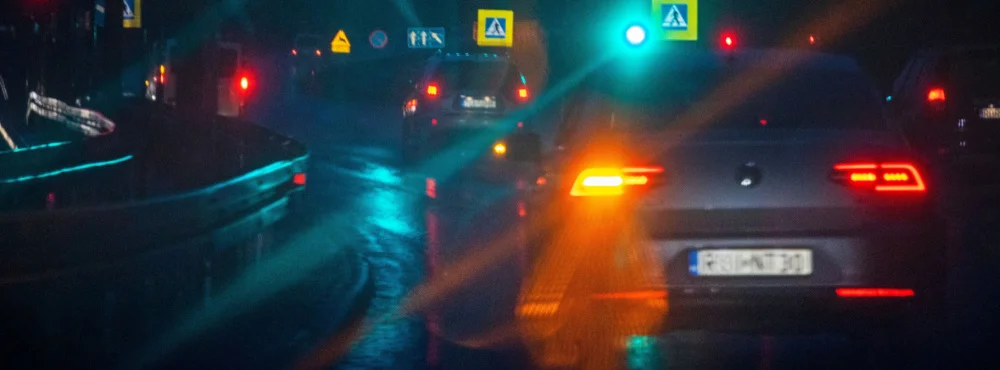
Patients affected by glare describe seeing rainbow has spectrum of colored bands proceeding in rainbow-like fashion. The effect is most prominent in the dark when looking at pinpoint light sources, such as oncoming car headlights at night.

When looking at monochromatic sources (for example a green neon gold traffic light), lacross vertical and "ghosts" or replications or the source can be perceived.[6]
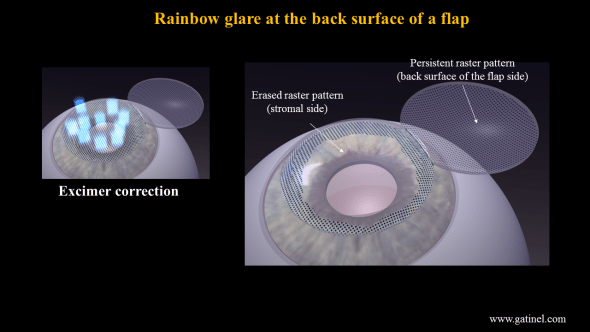
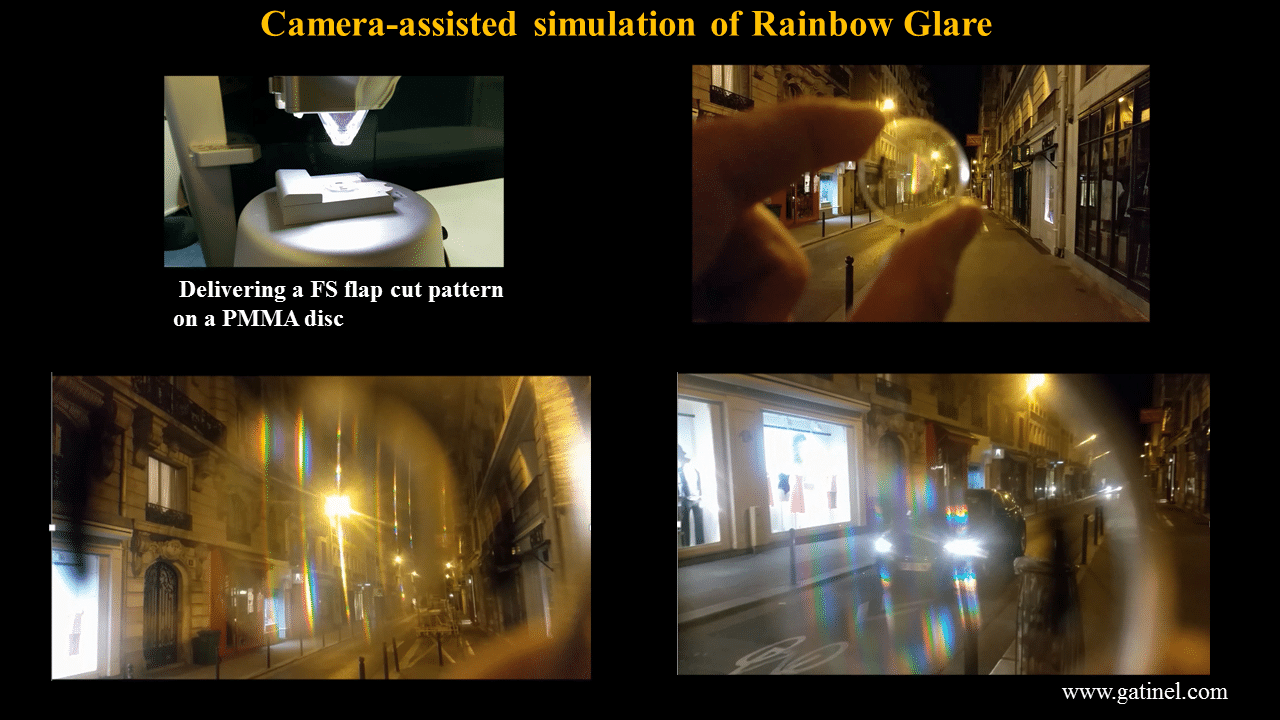
Rainbow glares are caused by femtosecond laser spots which cause constructive interference due to plasma disruption leading to splitting of light into its constituent colours with blue being closest to point light source and red colour being farthest. So defect lies in the poor laser alignment during raster type pattern of corneal flap formation. But if the laser spots are made in a random array rather than in a regular pattern, this phenomenon usually disappears. Patients who undergo this treatment develop around 4 to 12 bands usually with 6 being the commonest. With study it has been found that there's no relationship of developing rainbow glare with age, gender and refractive error but a positive association has been found with laser energy used particularly seen with 1.0 microJ or 1.1 microJ.34 Another study has reported the corneal flap interface to be the source of rainbow glare postoperatively.[5]
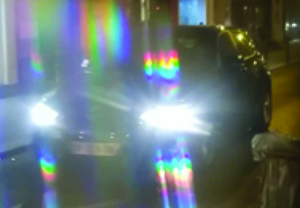
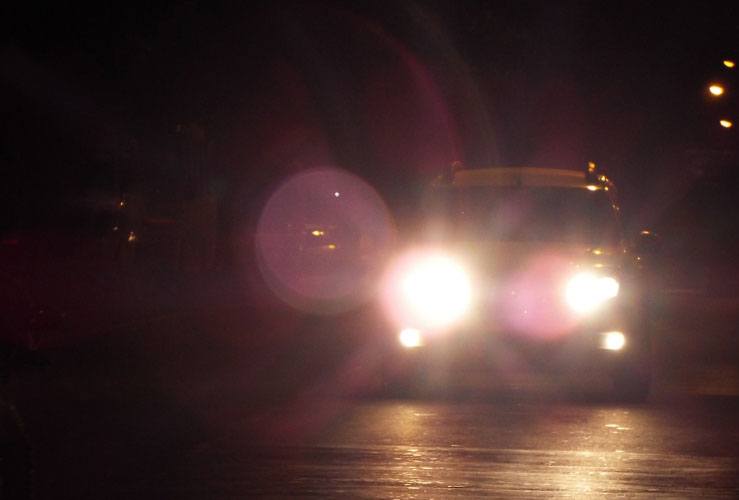
Image result for lasik night vision halos

It can be impossible for the brain to adapt, and remember, as pupils get larger, more light is let in, and the worse the distortion. Those with large pupils are particularly at risk of problems. It is almost impossible to correct these problems once introduced, have a google, and you will see many websites written by people with these specific problems, many of whom have tried ‘retreatments’ to no avail. In fact for many people, retreatments have made their problems far worse.

A large number of post LASIK patients initially have very good visual acuity, perhaps 20/20 in bright daylight, but are partially sighted in other environments, such as in the office, where there is only artificial lighting. Incidentally, artificial lighting has less of the spectrum of light that normal daylight has and therefore does not provide enough light for the post LASIK eye.

If you enjoy having an active lifestyle, driving at night, going to the movies, watching TV, using a computer (under artificial lighting – not necessarily in the dark), then we believe you are a poor candidate for Laser Vision Correction.[3]

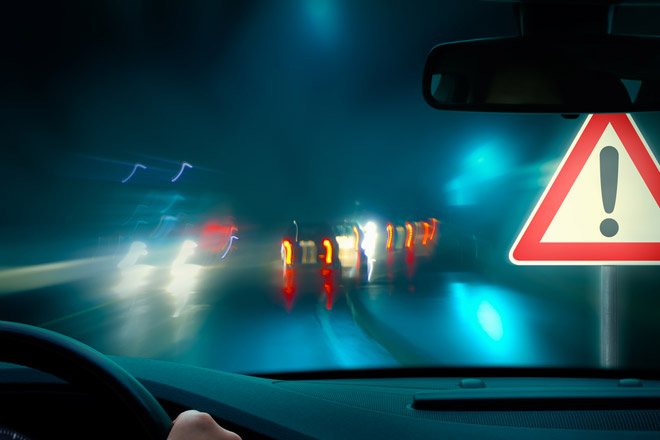
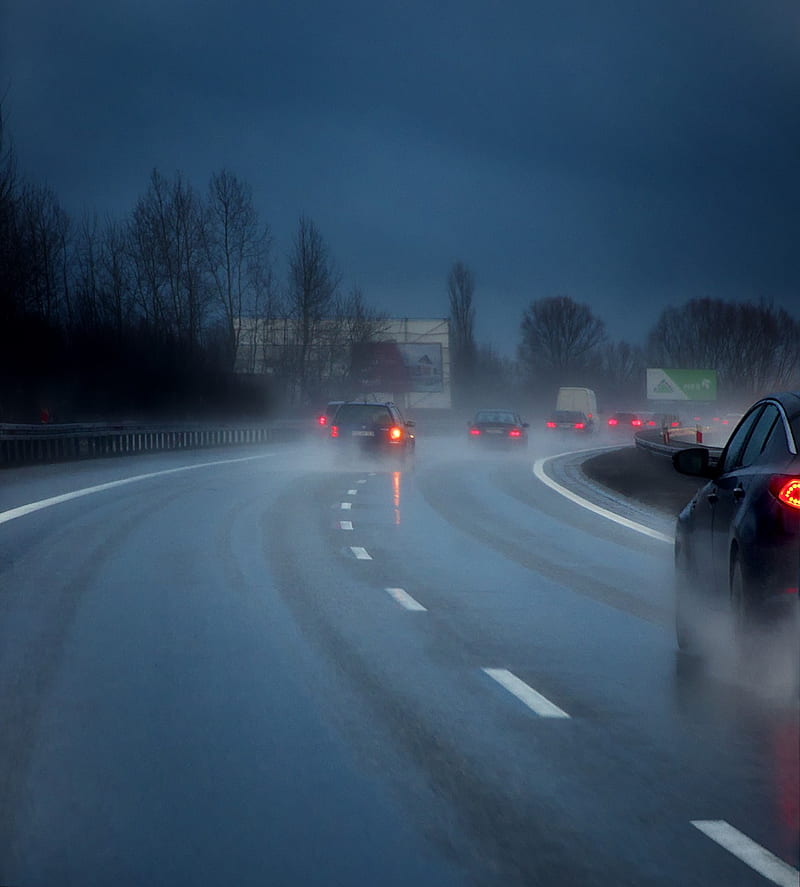
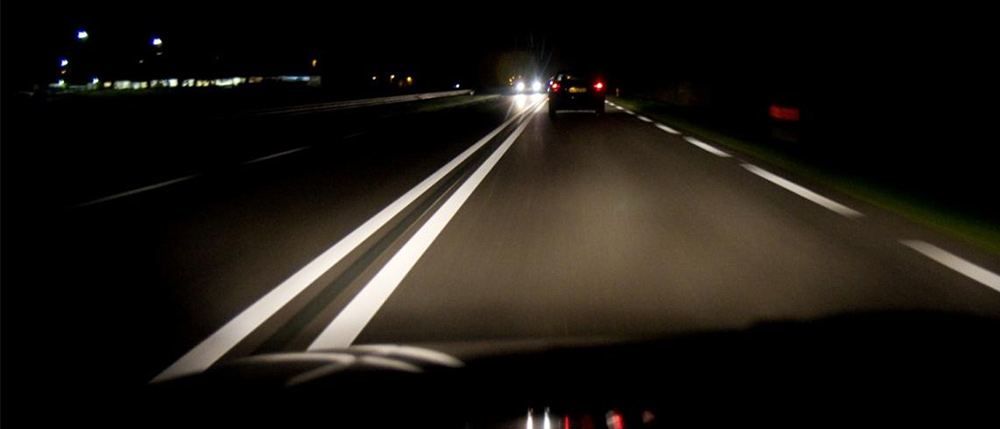
Many people struggle with night driving. Some have a terrible time with the glare of oncoming headlights. Others have difficulty seeing street signs or judging distance especially when it is raining or foggy.
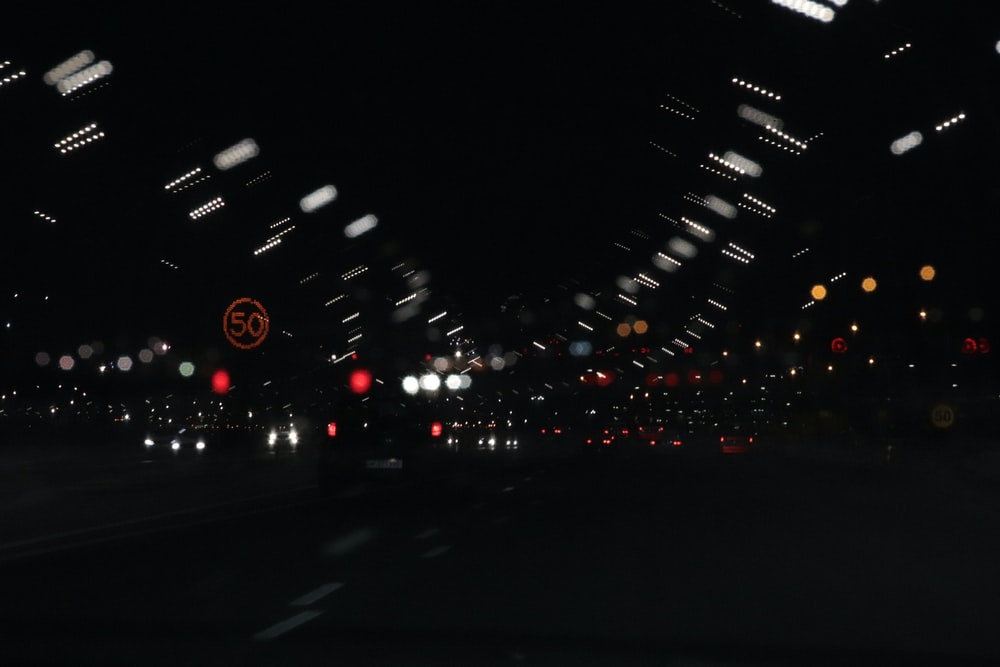
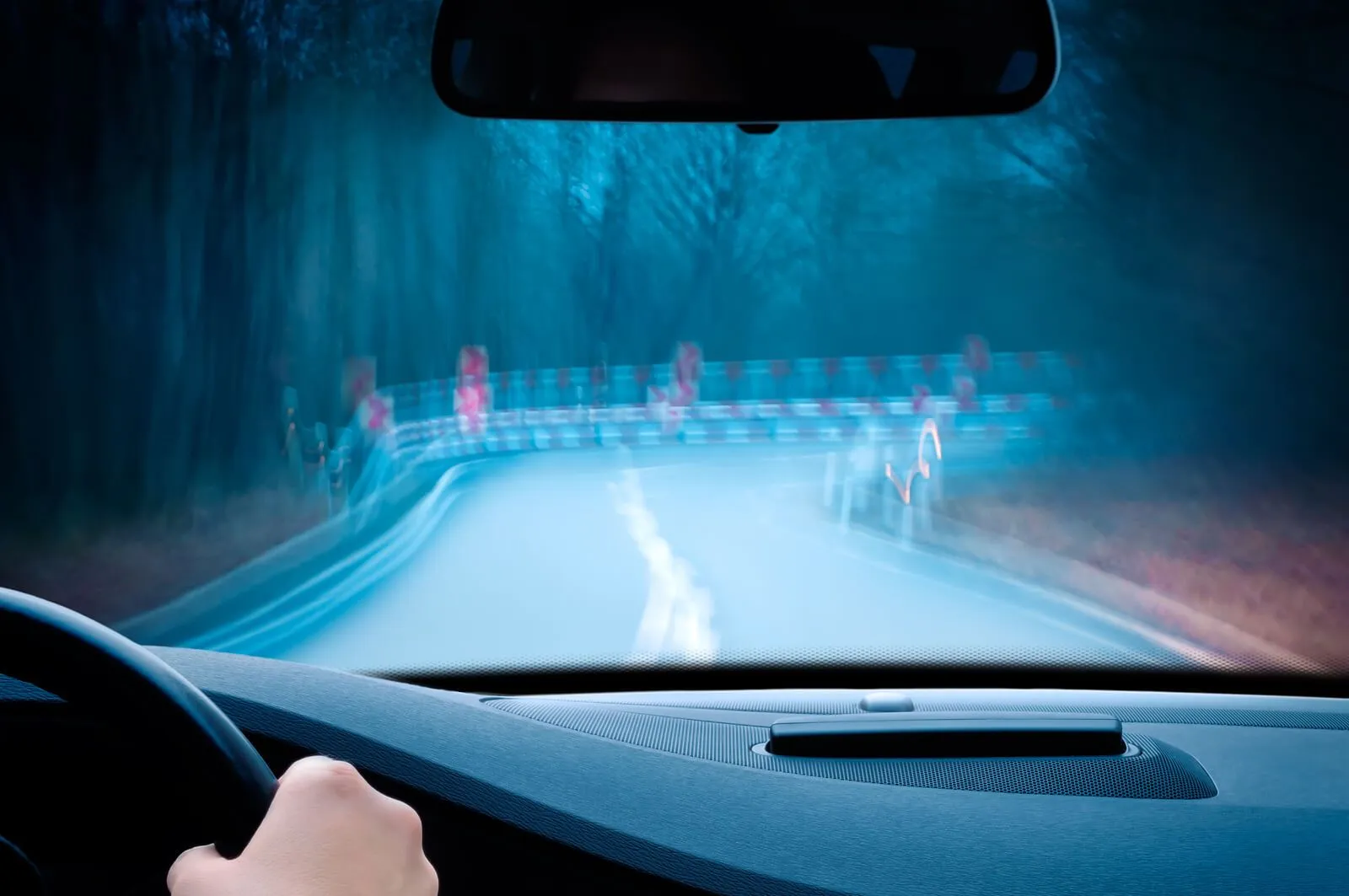
Why is night driving so dangerous? One obvious answer is darkness. According to the National Safety Council 90% of a driver’s reaction time depends on vision, and vision is severely limited at night. Depth perception, visual acuity, colour recognition, and peripheral vision are compromised after sun down. Older drivers have even greater difficulty seeing at night. A 50 year old driver many need twice as much light as a 30 year old. Older drivers also take longer to recover from glare.

Corneal irregularities vary widely among LASIK patients. Consequently, visual aberrations reported by LASIK patients also vary widely. Patients may complain of blurry vision, ghost images, starbursts, smeared vision, halos around lights or illuminated objects, and loss of contrast sensitivity (inability to distinguish detail in dim light). Glasses and soft contact lenses cannot correct these aberrations.[7]

Fortunately, you can take steps to minimize after-dark dangers by preparing your car and yourself. Be sure to mention your night driving difficulties at the time of your eye examination.

Prescription lenses may need to be worn for night driving. This prescription may be different than your daytime distance glasses due to night myopia. The prescription may require prism.

Headlights, tail lights and street lights create glare which can make night driving more difficult. Glare is a distracting problem that may cause the driver to lose sight of the road. Optometrists recommend an anti-glare coating on your glasses to reduce glare and provide more comfortable night-time vision.

How to reduce night glare after LASIK? [14]

  1. Prescription Eye Drops. Your doctor will prescribe you to use eye drops regularly, as they are designed to reduce inflammation, swelling, and dryness in the eyes. Not only will this reduce LASIK halos and glare, but will also speed up the healing process.
  2. Special Lenses & Contacts. By limiting the amount of light that enters the eye, halos, and glare can be reduced without compromising your vision. However, you may notice that the effectiveness of these lenses are reduced at night. This is largely due to lights at night being more directional and focused than their ambient, day-time counterparts.
  3. Further Surgery. Under and overcorrection can cause halos and glare, so it’s not uncommon for a surgeon to recommend LASIK enhancement surgery in cases where vision is continuing to be negatively impacted. This basically involves repeating the LASIK treatment, touching up problem areas with an excimer laser, and repositioning the corneal flap.
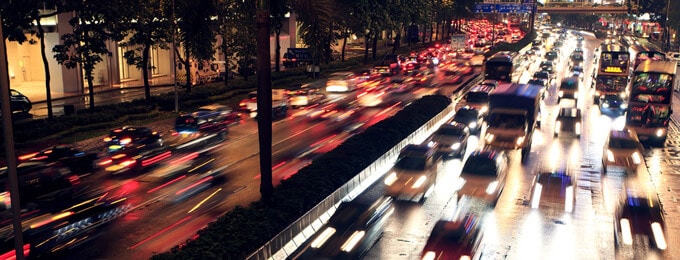
  • Contrast enhancement or glare reduction filters may need to be prescribed. These lenses are usually yellow or orange in colour. They are quite effective especially in rainy conditions. If you find yourself wearing sunglasses at night, you might be better off with one of these filters instead. These lenses are available in both prescription and non-prescription.
  • Dry eyes can make night driving worse. Artificial tear drops are helpful.
  • Central vision could be affected by dry eye, macular degeneration, diabetes, high blood pressure or medication.
  • Clean your windshield inside and out.
  • Apply a water repellent such as Rain X to the outside surface of all windows and windshield.
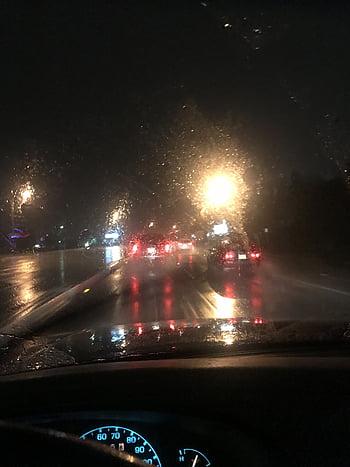
The faster your speed, the less reaction time you have. With objects already more difficult to see because of reduced lights, adjustment to lower speeds is necessary. Avoid driving when you feel fatigued and take breaks during long trips.

Avoid smoking while you drive. Smoke’s nicotine and carbon monoxide hamper night driving. The residue is also left on the inside of the windshield.

When approaching oncoming vehicles keep the eyes roving especially to the right.[4]

Does night glare go away after LASIK?

In most cases, the halos and glare you see after LASIK will not go away for about two to three weeks. However, it is common for you to see the halos and glare for a month after the LASIK surgery or possibly even longer than this.[8]
Reference:

  1. en.wikipedia.org/wiki/Night_vision
  2. verywell.com/night-vision-after-lasik-3421969
  3. lasikscandal.com/What/LASIK-Visual-Quality-Night-Vision-Problems-Disturbances-NVD
  4. lidkea.com/services-night-driving.html
  5. jpma.org.pk/article-details/8166
  6. gatinel.com/en/recherche-formation/diffraction/rainbow-glare-symptoms-causes-treatment
  7. lasikcomplications.com
  8. ccrsclearvision.com/blog/glare-and-halos-after-lasik-everything-you-should-know
  9. gatinel.com/recherche-formation/diffraction/rainbow-glare-symptoms-causes-treatment
  10. raleigheyecenter.com/blog/seeing-double-common-causes-of-double-vision-laser-eye-surgery-raleigh.html
  11. modestoeyecenter.com/lasik/lasik-night-vision-and-dry-eye
  12. sightmd.com/blog/lasik-and-night-vision-problems
  13. pubmed.ncbi.nlm.nih.gov/14738502
  14. brimhalleyecenter.com/lasik/halo-and-glow-after-lasik

See Also:

  • Night Vision after LASIK -- lasikdisaster.com
  • LASIK and Poor Night Vision -- chicagocornea.com
  • Night Vision Problems After LASIK -- lasikcomplications.com
  • For Some, Lasik Brings More Problems Than Solutions -- npr.org
  • Night Vision And Driving: How Safe Are Older Motorists? -- allaboutvision.com
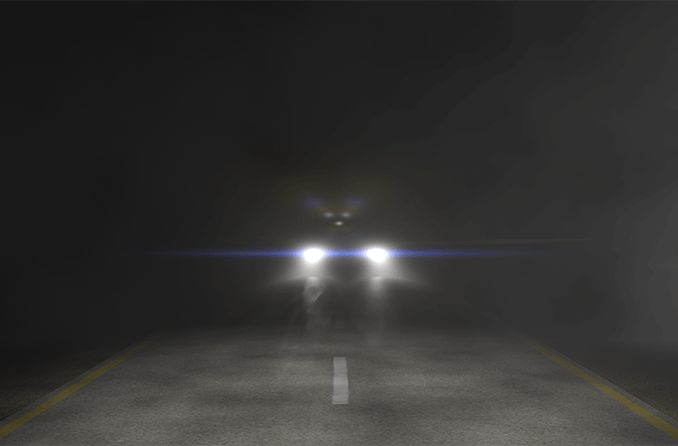
شب کوری برخلاف آنچه از اسمش برمی‌آید، ازدست‌دادن کامل بینایی در شب نیست، بلکه در افراد مبتلا به شب کوری توانایی دید در شب یا جاهای کم‌نور کمتر از حد معمول است. شب کوری برخلاف کوررنگی، به‌خودیِ خود اختلال نیست، بلکه نشانه‌ی بیماری دیگری است. شب کوری ممکن است در همه‌ی افراد و در همه‌ی سنین، حتی در کودکان رخ بدهد.

Night blindness (nyctalopia)

Night blindness (nyctalopia) occurs when a person has significant difficulty seeing in poorly lit environments. While it is relatively normal to experience some blurriness and trouble seeing clearly at night (due to a visual acuity issue), night blindness may be a warning sign of a serious eye condition.

There are two types of light-sensitive cells called rods and cones in the retina. The rods help us see in dim light while the cones enable us to see in brightly-lit settings. Nyctalopia is caused when the rods lose their ability to focus properly at night and under dim light

due to the following:

  • Pre-existing health conditions such as cataracts, glaucoma, and diabetes
  • A vitamin A-deficient diet
  • Other causes may include medications used to treat glaucoma and a genetic disorder called retinitis pigmentosa.

Retina-related causes of night blindness include: Rare, genetic retinal diseases like cone-rod dystrophy, retinitis pigmentosa (also called rod-cone dystrophy, similar to but not the same as cone-rod dystrophy) or congenital stationary night blindness (CSNB).

بینایی در شب از جهات بسیاری با بینایی در روز متفاوت است. چشم انسان در تاریکی اصولا کوررنگ است، حدت بینایی ضعیف است و چشم تنها بخشی از آنچه را در روز می‌بیند، در شب هم می‌تواند ببیند. دلیل آن یک اسکوتوم مرکزی (ناحیه‌ای با کاهش دید) است که در مرکز میدان دید ظاهر می‌شود و بنابراین چشم نمی‌تواند آن‌طور که اشیای متحرک را شناسایی می‌کند، اشیای ایستا را نیز تشخیص بدهد.

اگر دیدتان در شب ضعیف است، اما طی روز یا در جایی که نور کافی دارد مشکلی ندارید و عادی می‌بینید، به احتمال زیاد به شب کوری دچارید. در این‌صورت نمی‌توانید اشیایی را که دیگران در شب به‌راحتی می‌بینند، ببینید و وقتی از محیط روشن به محیطی تاریک می‌روید، مثلا وارد سالن سینما می‌شوید، چشم‌هایتان برای سازگاری و تطابق با اطراف به زمان بیشتری نیاز دارد.

Hemeralopia (from Greek ημέρα, hemera "day"; and αλαός, alaos "blindness") is the inability to see clearly in bright light and is the exact opposite of nyctalopia (night blindness). Hemera was the Greek goddess of day and Nyx was the goddess of night. However, it has been used in an opposite sense by many non-English-speaking doctors. It can be described as insufficient adaptation to bright light. It is also called heliophobia and day blindness.

In hemeralopia, daytime vision gets worse, characterised by photoaversion (dislike/avoidance of light) rather than photophobia (eye discomfort/pain in light) which is typical of inflammations of eye. Nighttime vision largely remains unchanged due to the use of rods as opposed to cones (during the day), which are affected by hemeralopia and in turn degrade the daytime optical response. Hence many patients feel they see better at dusk than in daytime.

Causes

Hemeralopia is known to occur in several ocular conditions. Cone dystrophy and achromatopsia, affecting the cones in the retina, and the anti-epileptic drug Trimethadione are typical causes. Adie's pupil which fails to constrict in response to light; Aniridia, which is absence of the iris; Albinism where the iris is defectively pigmented may also cause this. Central Cataracts, due to the lens clouding, disperses the light before it can reach the retina, is a common cause of hemeralopia and photoaversion in elderly.

C.A.R (Cancer Associated Retinopathy) seen when certain cancers incite the production of deleterious antibodies against retinal components, may cause hemeralopia. Another known cause is a rare genetic condition called Cohen Syndrome (aka Pepper Syndrome). Cohen syndrome is mostly characterized by obesity, mental retardation, and craniofacial dysmorphism due to genetic mutation at locus 8q22-23. Rarely it may have ocular complications such as hemeralopia, pigmentary chorioretinitis, optic atrophy or retinal/iris coloboma, having a serious effect on the person's vision. Yet another cause of hemeralopia is uni- or bilateral postchiasmatic brain injury. This may also cause concomitant night blindness.

Management

People with hemeralopia may benefit from sunglasses. Wherever possible, environmental illumination should be adjusted to comfortable level. Light-filtering lenses appear to help in people reporting photophobia.Otherwise, treatment relies on identifying and treating any underlying disorder.

Nyctalopia /ˌnɪktəlˈoʊpiə/ (from Greek νύκτ-, nykt- "night"; ἀλαός, alaos "blind, not seeing", and ὄψ, ops "eye"), also called night-blindness, is a condition making it difficult or impossible to see in relatively low light. It is a symptom of several eye diseases.

Night blindness may exist from birth, or be caused by injury or malnutrition (for example, a lack of vitamin A). It can be described as insufficient adaptation to darkness. eResearch by Navid Ajamin -- summer 2013

The most common cause of nyctalopia is retinitis pigmentosa, a disorder in which the rod cells in the retina gradually lose their ability to respond to the light. Patients suffering from this genetic condition have progressive nyctalopia and eventually their daytime vision may also be affected. In X-linked congenital stationary night blindness, from birth the rods either do not work at all, or work very little, but the condition doesn't get worse. Another cause of night blindness is a deficiency of retinol, or vitamin A, found in fish oils, liver and dairy products.

The opposite problem, the inability to see in bright light, is known as hemeralopia and is much rarer.

What causes night blindness?

Night blindness has many causes, including:

  • Myopia
  • Glaucoma medications that work by constricting the pupil
  • Cataracts
  • Retinitis pigmentosa
  • Vitamin A deficiency

To determine what is causing night blindness, an eye doctor will perform a thorough eye exam and may order any of a number of specialized exams.

How is night blindness treated?

Treatment for night blindness will depend upon its cause. Treatment may be as simple as getting a new eyeglass prescription or switching glaucoma medications, or it may require surgery if the night blindness is caused by cataracts.

If a retinal disease is discovered, the treatment will depend on the type of the disease and will require additional investigation by a retina specialist.

افرادی که به شب کوری دچارند، اغلب نمی‌توانند شب‌ها رانندگی کنند. اگر دیدتان در شب ضعیف است، حتما برای معاینه سری به چشم‌پزشک بزنید.

دلایل شب کوری

شب کوری (nyctalopia) یا ضعف سازگاری با تاریکی، به‌علت اختلال سلول‌هایی در شبکیه‌ی چشم است که مسئول دید در روشنایی اندک هستند. شب کوری ممکن است نشانه‌ی بیماری‌های مختلف اکتسابی یا مادرزادی باشد.

علت‌های اکتسابی

آب‌ مروارید (cataracts): افراد مبتلا به آب‌مروارید اغلب و به‌ویژه در شب نمی‌توانند به‌خوبی کتاب بخوانند، رانندگی کنند و حالت‌های چهره‌ را تشخیص بدهند.
نزدیک‌بینی (myopia): گاهی علت شب کوری، نزدیک‌بینی درمان‌نشده است.
مصرف بعضی داروها: بعضی داروهای آب‌سیاه یا گلوکوم (glaucoma) مردمک چشم را ضعیف و دید در شب را با مشکل مواجه می‌کنند.
کمبود ویتامین A: شب کوری یکی از اولین نشانه‌های کمبود ویتامین A است که معمولا با سوء‌تغذیه در ارتباط است. کمبود ویتامین اغلب در کودکانی رخ می‌دهد که دچار سوء‌تغذیه هستند. این کودکان آن‌قدر کم‌سن‌وسال هستند که نمی‌توانند مشکل دیدشان در شب را تشخیص بدهند یا مشکل بینایی خود را بازگو کنند.

علت‌های مادرزادی

شب کوری مادرزادی، با یا بدون نزدیک‌بینی: این مورد به گروهی از اختلالات ناهمگن ژنتیکی (جهش ژنتیکی) برمی‌گردد. نوعی از شب کوری مادرزادی (choroideremia) فقط روی جنس مذکر اثر می‌گذارد؛ جنس مؤنث حامل ژن‌های مربوطه است، اما نشانه‌های این بیماری را ندارد؛
رتینیت پیگمنتوزا (Retinitis pigmentosa): این بیماری چشمی درنتیجه‌ی چندین نقص چشمی اتفاق می‌افتد که منجر به آسیب شبکیه می‌شوند. افراد مبتلا ممکن است در شب یا روشنایی کم، کاهش دید داشته باشند؛ حتی ممکن است در دید میانی و جانبی نیز مشکل داشته باشند. نشانه‌های این بیماری در دوران کودکی قابل شناسایی هستند، اما اغلب در بزرگسالی آشکار می‌شوند.
سندرم آشر (Usher syndrome): این سندرم با کاهش شنوایی و رتینیت پیگمنتوزا شناخته می‌شود و همان‌طور که قبلا گفتیم ممکن است باعث شب کوری شود.

آزمایش شب کوری

اگر شب‌ها نمی‌توانید به‌خوبی ببینید، باید به چشم‌پزشک مراجعه کنید. در چنین مواردی، چشم‌پزشک آزمایش‌هایی انجام می‌دهد تا مشخص شود آیا به شب کوری مبتلا هستید یا نه، و آیا این شب کوری به بیماری دیگری ارتباط دارد یا خیر.

معاینه‌ی چشم شامل موارد زیر است:

  • آزمایش‌هایی برای بررسی حدت بینایی
  • توانایی تشخیص رنگ‌ها و واکنش مردمک چشم به روشنایی
  • آزمایش انکسار برای بررسی تجویز عینک یا لنز چشم
  • معاینه‌ی لامپ اسلیت برای بررسی ساختارهای جلوی چشم ازجمله ملتحمه، قرنیه، پلک‌ها، عنبیه، عدسی‌ها و صلبیه؛
  • معاینه‌ی شبکیه برای بررسی وجود هرگونه آسیب در ساختارهای پشت چشم ازجمله زجاجیه، شبکیه و مشیمیه.

ممکن است چشم‌پزشک الکترورتینوگرافی (Electroretinography) تجویز کند. این آزمایش واکنش‌های الکتریکیِ سلول‌های استوانه‌ای‌ و مخروطی‌ (سلول‌های گیرنده‌ی نور) را در معرض نور بررسی می‌کند و می‌تواند عملکرد غیرطبیعی شبکیه، یعنی بخش تشخیص نور چشم را شناسایی کند.

ممکن است آزمایش میدان دید هم روی فرد انجام شود. این آزمایش مشکلات دید میانی و جانبی را که بر اثر گلوکوم و دیگر بیماری‌های چشمی یا به‌واسطه‌ی مسائلی هم‌چون سکته‌ی مغزی ایجاد شده‌اند، تشخیص می‌دهد.

درمان شب کوری

اگر شب کوری بر اثر بیماری دیگری به‌وجود آمده باشد، معمولا بعد از درمان آن بیماری برطرف می‌شود. آب‌مروارید معمولا با جراحی درمان می‌شود و نزدیک‌بینی با تجویز عینک یا لنز بهبود می‌یابد.

در افراد مبتلا به آب‌سیاه یا گلوکوم، استفاده از داروهای مناسب ممکن است از شدت بیماری بکاهد. افرادی که کمبود ویتامین A دارند، معمولا به مکمل‌های غذایی و رژیم غذایی سالم واکنش خوبی نشان می‌دهند. درمان زودهنگام کمبود ویتامین A بسیار مهم است زیرا اگر بدون توجه رها شود، به کوری دائم منجر خواهد شد.

اگر شب کوری ناشی از اختلال مادرزادی باشد، دائمی است و افرادی که از این طریق دچار آسیب شده‌اند باید تحت نظر چشم‌پزشک باشند. این افراد باید بیشتر احتیاط کنند تا از آسیب‌هایی که ممکن است بر اثر دید ضعیف در شب به‌وجود بیایند، در امان بمانند.

برای درمان شب کوری، باید به‌طور منظم تحت نظر چشم‌پزشک باشید. شاید برای رانندگی در شب به عینک نیاز داشته باشید. برای کاهش خطر آسیب به خود و دیگران هنگام فعالیت‌های شبانه‌ هم‌چون رانندگی، تشخیص زودهنگام این بیماری بسیار اهمیت دارد.

Vitamin A, also known as retinol, is a nutrient that plays an essential role in the function of your retina. The retina is located in the back of your eye and is responsible for image processing. Without enough vitamin A in your body, your retina can’t work as well as it should. A Vitamin A deficiency is often the cause of diet or underlying health conditions. Luckily, plenty of foods are rich in vitamin A, such as kale, seaweed, carrots, fish oils, dairy, and much more.

Although incorporating vitamin A-rich foods into your diet is a great way to promote the longevity of your eye health, you should always tell your eye doctor if you’re experiencing any changes in your vision.

Zinc Deficiency

Zinc is an essential nutrient for eye health and retina function as well. This important mineral can even help prevent eye diseases like macular degeneration. However, when your body doesn’t get enough zinc, this can cause vision problems such as night blindness.

A great way to increase your zinc intake naturally is through your diet. Meats, shellfish, dairy, eggs, and legumes are all excellent sources of zinc.

پیشگیری از آسیب ناشی از شب کوری
رانندگی در شب برای این بیماران خطرناک است، زیرا سرعت واکنش راننده هنگام رانندگی به دید او بستگی دارد. حتی دید طبیعی در شب بسیار محدودتر از روز است. رانندگان مسن‌ در مقایسه با جوان‌ترها، هنگام رانندگی در شب دید کمتری دارند. برای مثال راننده‌ی پنجاه ساله، به نوری دوبرابرِ راننده‌ی سی ساله نیاز دارد.

بهترین راهِ محافظت از خودتان در برابر آسیب‌های ناشی از شب کوری، اجتناب از رانندگی در شب است. سعی کنید صرفا در طول روز رانندگی کنید. کسانی که به شب کوری دچارند ممکن است حتی زیر نورهای مصنوعی هم با مشکل مواجه شوند. اگر واجب است شب‌ها رانندگی کنید، نکاتی را برای ایمنی بیشتر رعایت کنید. مثلا با تمیز کردنِ شیشه‌ها و چراغ‌های جلوی خودرو، دید خود را افزایش بدهید؛ با سرعت کمتری رانندگی کنید تا در صورت بروز اتفاقات غیرمنتظره، بتوانید سریع‌تر واکنش نشان بدهید.

Reference:

  • my.clevelandclinic.org/health/symptoms/10118-night-blindness-nyctalopia
  • millervision2020.com/trouble-seeing-at-night-all-about-night-blindness
  • heinfolist.com/php/SummaryGet.php?FindGo=hemeralopia
  • neovisioneyecenters.com
  • researchgate.net/figure
  • clevelandclinic.org
  • chetor.com/119356
  • en.wikipedia.org
  • retinasocal.com

A 5-Minute Safety Training Aid

You are driving on a dark twolane road. An on coming vehicle’s high beams suddenly appear. The vehicle flashes past and for the next few seconds, you’re blind. You’ve just experienced a common hazard known as night blindness.

Night blindness occurs when the eye is accustomed to low levels of light and the light intensity
suddenly rises.
The eyes adjust to the new light level by contracting the pupils, but if that level of intensity is only momentary, then the eyes have to readjust to the lower level again by dilating the pupil.

While the eyes make these adjustments, there are several seconds that the vision is impaired.

During the day about 85 percent of the information we need to drive is visual, but at night this changes. Without enough light, we lose much of our contrast sensitivity (the ability to distinguish objects from the background) and peripheral vision (the ability to recognize objects at the edges of our visual field).

At night, headlights limit our visual range to the area they illuminate, only 250 to 350 feet of the road ahead.

At sixty miles per hour a car will cover 350 feet in four seconds. Therefore, slower driving speeds will allow you more time to spot a hazard and respond in a crisis.
With this in mind, pedestrians should wear light-colored clothing or put reflective tape on their clothes to make themselves more visible in the darkness.

If a driver turns his or her head from side to side, it will help make up for the lost side vision that occurs at night.

Also, if the driver must wear glasses to drive, frames that have thin sidepieces should be selected, since wide sidepieces will hinder side vision.

In addition to the problems listed above, there is the fact that as we age the lenses of our eyes become yellowed and we need more light to see. Most of us begin to notice this in our 40’s. By the age of 65 we need 2.5 times the light that we needed when we were 20 to see the same level of detail. For this reason, older persons should drive slower when they find it necessary to drive at night. Whatever your age, precautions must be taken to avoid accidents.

The following traffic safety do's and don’ts may help.

Do eResearch by Navid Ajamin -- spring 2013
+ Drive within the range of your headlights, not by what you think you see beyond your headlights.• + Adjust your rear view mirror to the “night” setting to dim headlight glare coming from behind. When the glare is gone, readjust to the “day” setting.
+ Focus your eyes on the right edge of the pavement to avoid being blinded by oncoming headlights.• + Clean your headlights.
+ Clean your windshield (inside and out).

+ Keep your eyes moving between the road and the rear and side-view mirrors.
+ Use your high beams when you can.• Take off sunglasses at dusk.
+ Turn your head from side to side to increase your peripheral vision.

+ Dim your instrument lights to reduce brightness when you look at them.

Don’t
Drive faster than sixty-five miles per hour at night, slower on winding roads.• Put dark aftermarket tinting film on windows and windshields.
Depend on fog or parking lights when driving at dusk or dawn.• Keep your high beams on when another vehicle approaches.
Exceed the speed for driving conditions at night in rain, snow or fog.• Turn your interior lights on while driving your vehicle.
Wear sunglasses at night.• Stare into your side-view mirrors as cars pass from behind.
Use any type of medication that may change your night vision or cause drowsiness.[1]

Night blindness doesn’t mean you are completely unable to see at night, but that your vision is poorer then. It is not a disease in itself, but instead is a symptom of some other type of vision problem.

In some cases, being very nearsighted (myopic) can make it hard to see at night or in low light.

Certain cells in the eye’s retina are responsible for allowing you to see in dim light. If these cells are affected by a disease or condition, night blindness occurs.

Some of the eye conditions that can cause night blindness include:

  • Nearsightedness (seeing well up close but not far away)
  • Glaucoma (a disease of the optic nerve connecting the eye to the brain)
  • Medicine for glaucoma that constricts (narrows) the pupil
  • Cataracts (cloudiness of the eye’s naturally clear lens)
  • Diabetes (uncontrolled blood sugar levels)
  • Retinitis pigmentosa (an eye disease that causes blindness)
  • Too little Vitamin A
  • Keratoconus (having a cornea that is very steeply curved)

Is bumping and tripping through your darkened house normal or a symptom of something else?

If you aren’t sure whether you have night blindness, consider the following questions:

  • Do you find yourself having trouble moving around your house at night, even with small night lights?
  • Is driving at night becoming more difficult?
  • Do you avoid going outside at night for fear of tripping?
  • Do you have trouble recognizing people’s faces in darkened settings?
  • Does it take your eyes a long time to adjust to light when coming in from the darkness?
  • Similarly, does it take you a long time to adjust to seeing anything in a darkened room?

If you have any concerns about your ability to see in the dark or in dim light, speak with your ophthalmologist right away. Having a complete eye exam will help identify any condition affecting your vision.

Treating night blindness depends solely on its cause. If your refractive error is significant, getting a new prescription for your eyeglasses may be all you need for better vision in low light. In some cases, having cataracts removed can be illuminating as far as your vision is concerned. Your ophthalmologist can explain what is causing your night blindness and suggest how to brighten your outlook.[2]

Humans are not designed to be creatures of the night, so remember to respect the road and the darkness.

The Fédération Internationale de l'Automobile (FIA) created the Golden Rules for Road Safety as guidelines for drivers to keep themselves and other road users safer in transit. To start: Check your vision regularly, protect your eyes from glare and always wear your glasses on the road. The FIA also advises that motorists: [3]

  • Always pay attention
  • Obey the speed limit
  • Buckle up
  • Use a child safety seat
  • Check their tyres
  • Don't text and drive
  • Stay bright in reflective gear
  • Wear a helmet
  • Stop when they're tired
  • Watch out for pedestrians, especially kids
  • Slow down for kids
  • Never drink and drive

Reference:

  1. tdi.texas.gov
  2. aao.org/eye-health/news/shedding-light-on-night-blindness
  3. essilor.com/ie-en/blog/your-life-and-your-eyes/cannot-see-when-driving-at-night

Night Vision Problems: Halos, Blurred Vision, and Night Blindness

Are you having problems with night vision? Millions of Americans do. Poor night vision may simple be an early sign of progressive cataracts. Problems with night vision -- or at the extreme, night blindness -- may be treatable or could be a sign of a congenital problem such as retinitis pigmentosa or other more serious conditions.

What Causes Poor Night Vision?

Difficulty with night vision can also stem from exposure to the sun and vitamin deficiencies to a chronic disease such as diabetes:

Cataracts. The lens of the eye is located behind the pupil. Over a lifetime, the process of cell turnover inside the lens produces debris that gradually builds up. This creates a cataract. Painless and progressive, cataracts slowly cloud the lens.

The first symptom of cataracts is usually decreased night vision. The light distortion caused by cataracts also frequently produces halos around lights -- again, mostly at night. Blurry vision is also  common.

Vitamin A deficiency . Vitamin A is an essential vitamin that's found in carrots and yellow or green leafy vegetables. It helps keep the retina -- in the back of the eye -- healthy. Vitamin A deficiency is a rare cause of night blindness in the U.S. It occurs mostly in people with problems absorbing nutrients from the gut. This might occur as a result of different diseases and conditions such as Crohn's disease, celiac disease, cystic fibrosis, or pancreatic insufficiency.

Zinc deficiency. Zinc works in the eye as a partner to vitamin A. Without zinc, the vitamin A hat's present may not be as effective, and night blindness could result. Beef, poultry, beans, and nuts are rich sources of zinc. This dietary deficiency is uncommon in this country.

Retinitis pigmentosa . Retinitis pigmentosa is an uncommon genetic disorder. It affects young people, usually before age 30. Worsening night vision is often the earliest symptom. Variable amounts of vision loss follow, although most people retain some vision.

Sunlight exposure. If your night vision seems temporarily worse after a trip to the beach, it probably is. Sustained bright sunlight can impair night vision for up to two days. Wear your sunglasses regularly to avoid this cause of poor night vision.

halos at night headlights

LASIK surgery problems. Complications after LASIK surgery are uncommon. However, some people do experience night vision problems after LASIK. The most common complaint is distorted vision in the form of glare and halos around objects.

Distorted vision may be present during the day, too. It becomes more noticeable and bothersome, though, at night. Some people are more prone to developing night vision problems after LASIK. Those who are can be identified before the surgery based on characteristics of their eyes. Ask about your own chances of complications if you're considering LASIK.  eResearch by Navid Ajamin -- summer 2011

Diabetes. People with diabetes are at higher risk for night vision problems. Over years, high blood sugar is toxic to the blood vessels and nerves in the eye. The retina -- the back of the eye where images are focused -- is gradually damaged (retinopathy). Two early signs of retinopathy from diabetes are poor night vision and taking a long time to see normally after coming indoors from bright light outside. 

Reference: webmd.com

Night blindness is a type of vision impairment also known as nyctalopia. People with night blindness experience poor vision at night or in dimly lit environments.Historically, nyctalopia, also known as moonblink, was a temporary night blindness believed to be caused by sleeping in moonlight in the tropics.Although the term “night blindness” implies that you can’t see at night, this isn’t the case. You may just have more difficulty seeing or driving in darkness.

Eyes vision: bad eye vision at night

Night blindness is a heterogeneous group of ophthalmological disorders that results in a diminished ability to see under scotopic (dim light) conditions.

There are both acquired and congenital forms of night blindness.

  • Acquired forms of night blindness include an insufficiency of vitamin A and paraneoplastic syndromes (melanoma-associated retinopathy and cancer-associated retinopathy).
  • Congenital forms include both stationary (in which the severity remains relatively constant throughout life) and progressive (in which severity increases over time) forms of night blindness.
  • Stationary forms can result from genetic mutations in rod photoreceptors or rod bipolar cells.
  • Progressive forms include retinitis pigmentosa, choroideremia, and gyrate atrophy.

Some types of night blindness are treatable while other types aren’t. See your doctor to determine the underlying cause of your vision impairment. Once you know the cause of the problem, you can take steps to correct your vision.

nyctalopia is a type of vision impairment. People with night blindness experience poor vision at night or in dimly lit environments. It is not a disease in itself, but rather a symptom of an underlying problem, usually a retina problem.

Your vision relies on light coming through your eye, hitting the retina at the back of the eye, being transmitted through the optical nerve, and processed by the brain.

? Will street lights damage night vision

At night, your pupils will get larger to allow more light in. The rod cells on your retina will collect more light, as they are more photosensitive than the cone cells. Your optic nerve will take this mostly black-and-white image to your brain, where it is interpreted into your surroundings.

What Causes Night Blindness?
A number of eye conditions can cause night blindness, including:

  1. Nearsightedness or blurred vision when looking at faraway objects.
  2. Cataracts or clouding of the eye's lens.
  3. Retinitis pigmentosa, which occurs when dark pigment collects in your retina and creates tunnel vision.
  4. Vitamin A Deficiency
  5. Zinc Deficiency
  6. Dry Eyes
  7. Diabetes

Are the Symptoms of Night Blindness?

To identify night blindness, the American Academy of Ophthalmology suggests that people consider the following questions:

  • Is moving around the house in dim light a challenge?
  • Is driving at night increasingly difficult?
  • Is it tricky to recognize faces in dim light?
  • Does it take an abnormally long time to adjust to a light room after being in the dark?
  • Does it take a long time to see in a darkened room after being in the light?

Other symptoms may also occur with night blindness. The nature of these symptoms will depend on the underlying cause but may include:

  • headaches
  • eye pain
  • nausea
  • vomiting
  • blurry, or cloudy vision
  • sensitivity to light
  • difficulty seeing into the distance

The sole symptom of night blindness is difficulty seeing in the dark. You're more likely to experience night blindness when your eyes transition from a bright environment to an area of low light, such as when you leave a sunny sidewalk to enter a dimly lit restaurant. You're likely to experience poor vision when driving due to the intermittent brightness of headlights and streetlights on the road.

How can I Prevent Night Blindness? eResearch by Navid Ajamin -- spring 2009

You can't prevent night blindness that's the result of birth defects or genetic conditions, such as Usher syndrome. You can, however, properly monitor your blood sugar level and eat a balanced diet to make night blindness less likely.

For many people around the world, night vision can be a problem. There are many root causes of night blindness, but the common symptom is the inability to see well or clearly at night.

Different causes of this condition will require different approaches to treatment. Getting regular eye exams to diagnose some issues before night blindness occurs can help to reduce your risk.

People with poor night vision typically are not able to see well in the dark. They are, however, able to see perfectly well during the day, even though transitions from bright environments to dim ones, such as when entering a darkened hall from the sunny outdoors, may be challenging.

One key to seeing at night is a healthy amount of rhodopsin, which is an eye pigment in the retina responsible for night vision. It is used specifically by the photoreceptor cone cells to perceive light, while the rods, on the other hand, are highly sensitive to darkness. Rhodopsin enables us to quickly adapt our vision from a dark room to a light room.

Vitamin A is an essential component of rhodopsin, so a deficiency in vitamin A can result in poor night vision. Though vitamin A deficiency is rare in industrial nations, there are other reasons vitamin A intake may be compromised, including:

  • Iron deficiency can affect vitamin A uptake.
  • Small-bowel bypass surgery may reduce vitamin A absorption.
  • Excess alcohol consumption impairs absorption.
  • Medications can affect fat absorption (Xenical) or cholesterol (statins).
  • Low fat diets may be low in vitamin A.
  • Zinc deficiency is associated with decreased release of vitamin A from the liver.
  • Other conditions such as fibrosis, pancreatic insufficiency, and inflammatory bowel disease affect how vitamin A is utilized in the body.

For people whose night vision begins worsening due to other related eye conditions, the vision loss can occur very slowly over time. It can also occur quickly, depending on how acute the eye condition is, such as with untreated retinal bleeding. Cataracts, for example, tend to develop slowly, but for a smaller percentage of the population, they can evolve rapidly.

Symptoms vary (based on the individual) and can include any or all of the following:

  • Weak vision in dim light
  • Difficulty seeing during night driving
  • Slow vision adaption between bright and dim light conditions (such as taking a longer time than other people to adjust to indoor lighting when coming from the bright outdoors)
  • Fifty to seventy percent of people with night blindness also have nystagmus and strabismus, as well as low vision and myopia.

Only your doctor can provide an adequate diagnosis of any signs or symptoms, and whether they are night blindness symptoms, or symptoms of another disorder. The determination of the cause of night blindness should be fairly easy with a full, dilated exam and targeted tests, such as an optical coherence tomography scan (commonly known an OCT scan). This is particularly important so that the eye doctor has a history of test results with the patient.

If the night blindness is genetic, your doctor may administer a test called an electroretinogram, which determines the function of the retina and therefore its proper classification.

Reference:

  • healthline.com/health/vision-night-blindness
  • en.wikipedia.org/wiki/Nyctalopia
  • nvisioncenters.com/education/night-blindness
  • researchgate.net/publication/284826657_Night_Blindness
  • lybrate.com/topic/night-blindness-causes-and-symptoms
  • naturaleyecare.com/eye-conditions/night-blindness
  • medicalnewstoday.com/articles/324004.php#what-are-the-symptoms

See also: Identifying a gene for canine night blindness

nicetoview.blogfa.com
عینک eyewear وبلاگ تخصصی عینک شامل مجموعه مطالب پزشکی است که اطلاعات مفیدی در رابطه با عینک , چشم، لنز، سلامتی چشم و راه های پیشگیری از بیماریهای چشمی، کنترل و درمان آن را در اختیار شما کاربر محترم می گزارد.

Always Be Healthy
همیشه سلامت باشید

Navid Ajamin نوید عجمین
eMail: navid.aj@outlook.com
موضوعات وب
پیوندها

unicef for every child

شمارنده