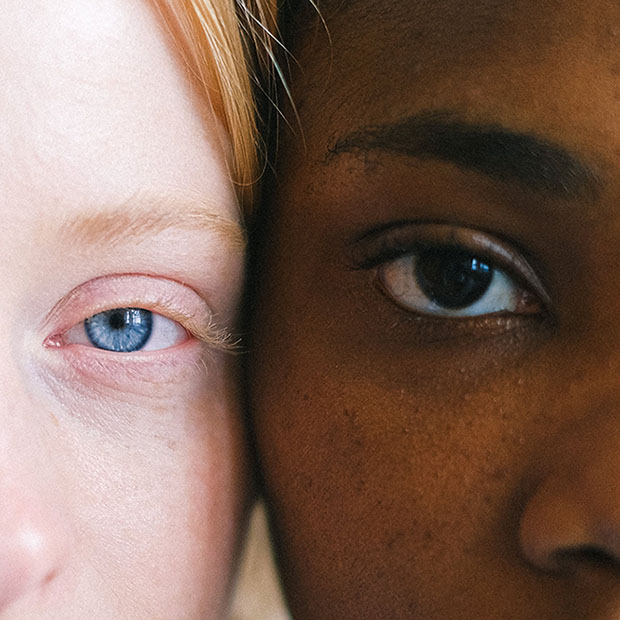
به طور كلی رنگ چشم بستگی به مقدار ماده ای به نام ملانیندارد. ملانین رنگدانه ی قهوه ای تیره است كه در عنبیه افراد وجود دارد. چشم آبی نشان دهنده میزان كم ملانین است، در حالی كه چشم قهوه ای حاوی مقدار زیادی از این ماده است. در نتیجه انسانهایی كه پوست و موی تیره دارند ، دارای مقدار زیادی ملانین هستند، بنابراین استعداد داشتن چشم قهوه ای را دارند ولی افرادی كه مو و پوست روشن دارند مقدار كمی از این رنگدانه دارند و رنگ چشم اكثر آنها روشن است.
به همین علت است كه بیشتر نوزادان با چشم آبی به دنیا می آیند ولی به مرور زمان وقتی بدن آنها شروع به تولید ملانین می كند ، رنگ چشم آنها هم عوض می شود. eResearch by Navid Ajamin -- winter 2011
وقتی كه یك انسان مقدار متفاوتی ملانین در هر یك از عنبیه هایش باشد، رنگ دو چشم او متفاوت خواهد بود.
"Heterochromia Iridium"( اصطلاح علمی برای داشتن رنگ چشم های متفاوت در یك جاندار) تقریباً در انسانها نادر ، ولی در بسیاری از حیوانات مثل اسب، گربه و بعضی از نژادهای سگ رایج است.
There are many types and causes of heterochromia. An infant can be born with it or develop it soon after birth. In these cases, it is called congenital heterochromia.
heterochromia het·ero·chro·mia -ˈkrō-mē-ə
: a difference in coloration in two anatomical structures or two parts of the same structure which are normally alike in color
In most cases, children born with heterochromia will experience no other symptoms. They do not have any other problems with their eyes or general health. However, in some cases heterochromia can be a symptom of another condition.
Causes of heterochromia in infants can include:
Horner’s syndrome
Benign heterochromia
Sturge-Weber syndrome
Waardenburg syndrome
Piebaldism
Hirschsprung disease
Bloch-Sulzberger syndrome
von Recklinghausen disease
Bourneville disease
Parry-Romberg syndrome
When a person gets heterochromia later in life, this is called acquired heterochromia.
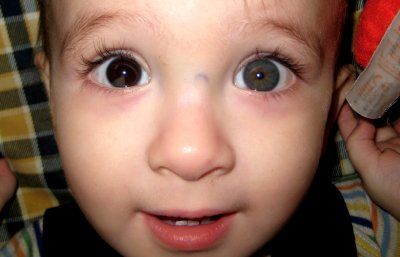
Young Boy With Different Colored Eyes
Causes of acquired heterochromia include:
Eye injury
Bleeding in the eye
Swelling, due to iritis or uveitis
Eye surgery
Fuchs' heterochromic cyclitis
Acquired Horner’s syndrome
Glaucoma and some medications used to treat it
Latisse, a repurposed glaucoma medication used cosmetically to thicken eyelashes
Pigment dispersion syndrome
Ocular melanosis
Posner-Schlossman syndrome
Iris ectropion syndrome
Benign and malignant tumors of the iris
Diabetes mellitus
Central retinal vein occlusion
Chediak-Higashi syndrome
این خصوصیت ( داشتن دو رنگ چشم متفاوت در یك فرد) نتیجه تغییرات در یكی از ژنهایی است كه رنگ چشم را كنترل می كنند كه می تواند ارثی باشد. البته صدمات و یا بعضی از داروهای خاص در افزایش و یا كاهش مقدار رنگدانه ها در یكی از عنبیه ها تاثیر می گذارد و یا حتی بعضی از سندرم ها مانند:Syndrome Waardendurg می تواند باعث بروز این خصوصیت درفرد شود. البته درحالیكه گروهی از این افراد از لنزهای رنگی برای تطابق دو چشم خود استفاده می كنند، عده ای دیگر به این خصوصیت بارز خود می بالند!
دلیلرنگی بودن چشم
the lack of melanin causes
چشم شما به شکل کره است، که در جلو يک برآمدگی دارد و نور از همان جا وارد چشم می شود. این برجستگی را قرنيه نامند ، که بی رنگ است. پشت آن به ترتيب مردمک و عنبيه چشم قرار دارند ، که اولی بر حسب مقدار نور، فراخ يا تنگ ميشود. دومي به شکل عدسي است که شکست نور را سبب ميشود. اگر به چشم افراد مختلف نگاه کنيد، آنها را در رنگهای مختلفي خواهيد ديد . چرا در افراد مختلف رنگ چشم متفاوت است؟ در داخل عنبيه ملانين (رنگدانهها) وجود دارند همان مادهای که پوست را رنگ مي کند . سلول های کوچک ملانين قهوه ای پررنگ هستند. اگر تعداد آنها زياد باشد. رنگ چشم ها قهوه ای سير خواهد بود ، وبر عکس کم بودن آنها باعث ميشود،که چشم ها قهوه ای پررنگ باشند.
البته رنگ چشم نمي تواند به طور کامل سياه باشد ،اما دليل آبي بودن برخي چشم ها را مي توان چنين توضيح داد : چشم هايي ميتوانند آبي باشند ، که ملانين کمتری دارند . در اين گونه چشم ها توده هاي کوچکي از ماده خاصي وجود دارند، که قابل رويت نيستند آنها از هفت رنگ تشکيل دهنده نور سفيد (قرمز- نارنجي – زرد- سبز- آبي – نيلي – بنفش)،که دريافت مي کنند، همه را جذب کرده، فقط آبي را پخش مي کنند . پس رنگ آبي چشم ، بازتاب ملانين هايي است، که در عنبيه قرار دارند.
Types of eye heterochromia
The different types of heterochromia of the eye include:
Central heterochromia
Central heterochromia is characterized by having two different colors in the same iris. Usually, the outer ring of the iris is one color while the inner ring is another.
The inner ring often seems to have "spikes" of different colors that radiate from the pupil or the black circle at the center of the iris. Eyes that have this pattern may be referred to as "cat eyes." The outer color is considered to be the true iris color in people with central heterochromia.
Central heterochromia tends to occur in irises that have low levels of melanin.
Complete heterochromia
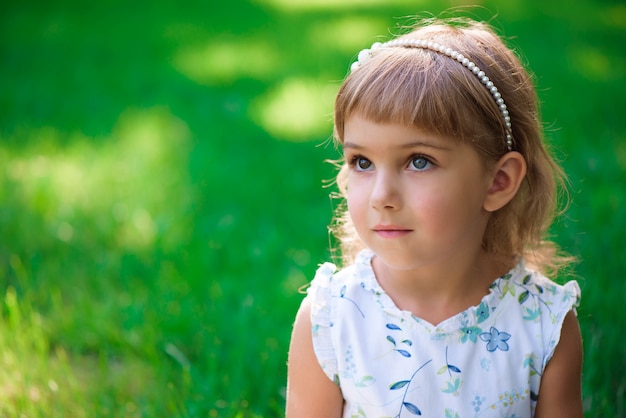
People with this condition have two different-colored eyes. For example, they may have one blue eye and one brown eye.
Sectoral heterochromia(Cat eye)
In people with sectoral heterochromia, also known as partial heterochromia, one part of the iris is a different color from the rest. Sectoral heterochromia often resembles an irregular spot on the iris of the eye and does not form a ring around the pupil.
Identifying heterochromia
Heterochromia of the eye is easy to identify. The person will have two different colored eyes or color differences within one or both eyes.
Color differences may be slight and may only become apparent under certain lighting conditions or in photographs.
Aside from variations in eye color, there are usually no other signs and symptoms of heterochromia. However, if a medical condition or trauma is responsible for the heterochromia, other signs and symptoms may be present.
Eyes come in many shades, ranging from dark to light brown, and from green, hazel, and gray, to blue. But despite the many variations that we perceive, there are actually only two different pigments in our eyes: brown and red.
The colored area at the front of the eye is called the iris. It is around 12 millimeters in diameter and has an opening in the middle, which is called the pupil. The iris is made from connective tissue and a thin muscle that allows it to open and close in response to light.
Our individual eye color is made up of different amounts of pigment and the connective tissue that forms part of the iris.
Dark eyes have the most pigment, particularly brown-black eumelanin.
Eye Color Genetics
Eye Color depends on pigmentation known as melanin that is produced by melanocytes (a specialized cell located in the front layers of the iris, the structure surrounding the pupil). Individuals have on average the same number of melanocytes, but the amount of melanin produced varies.
The color is determined by how much melanin is stored in the intracellular compartments known as melanosomes. Blue eyes have a minimal amount of melanin stored in a small number of melanosomes. Green eyes have a moderate amount of melanin and moderate melanosomes. Brown eyes have high amounts of melanin stored within many melanosomes.
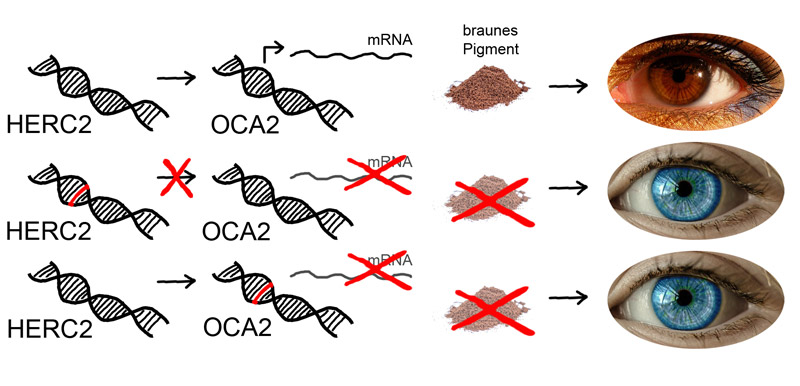
More than 150 genes influencing eye color have been found by researchers. Two genes located nearby each other on chromosome 15 play major roles in determining eye color. The first we will discuss called OCA2, codes for P protein, and is directly involved in melansome maturation and affects the amount of melanin stored in the iris. Genetic variations in this gene increase or reduce the amount of P protein leading to a dark or light eye color respectively. HERC2 is the other main gene involved, it controls expression of OCA2 which can increase or reduce how much P protein is produced.
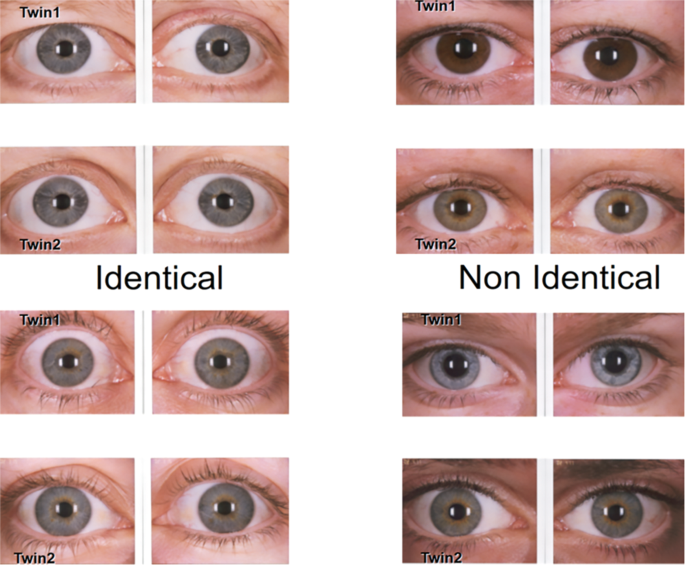
Eye color inheritance pattern is complex. A child’s eye color can generally be predicted by looking at the color of the parents eyes, but polymorphisms can arise and a child may have an unexpected eye color. Variations in genes are referred to as alleles. The allele for brown eyes is very dominant over the allele for blue eye, which is always recessive. This can lead to parents who happen to have the same eye color producing a child with different eye colors. For example if parents with brown eyes each pass on a pair of blue alleles to their offspring, the child would have blue eyes. But if one parents passes on a green allele, the child will have green eyes. If a brown allele is passed on, then the child will have brown eyes.
This however does not account for why parents with blue eyes can have children with brown eyes, nor does it explain grey or hazel eyes. Mutations and modifier genes can all lead to variability in eye color. Researchers are still studying exactly how these factors cause these unique variations.
In contrast, light blue eyes have the least amount of pigment. Light eye color is most prevalent in individuals of European descent.
However, there is no such thing as blue pigment in our eyes. Instead, an individual's eyes are blue because of the white collagen fibers in the connective tissue in the iris. These fibers scatter light and make the iris look blue.
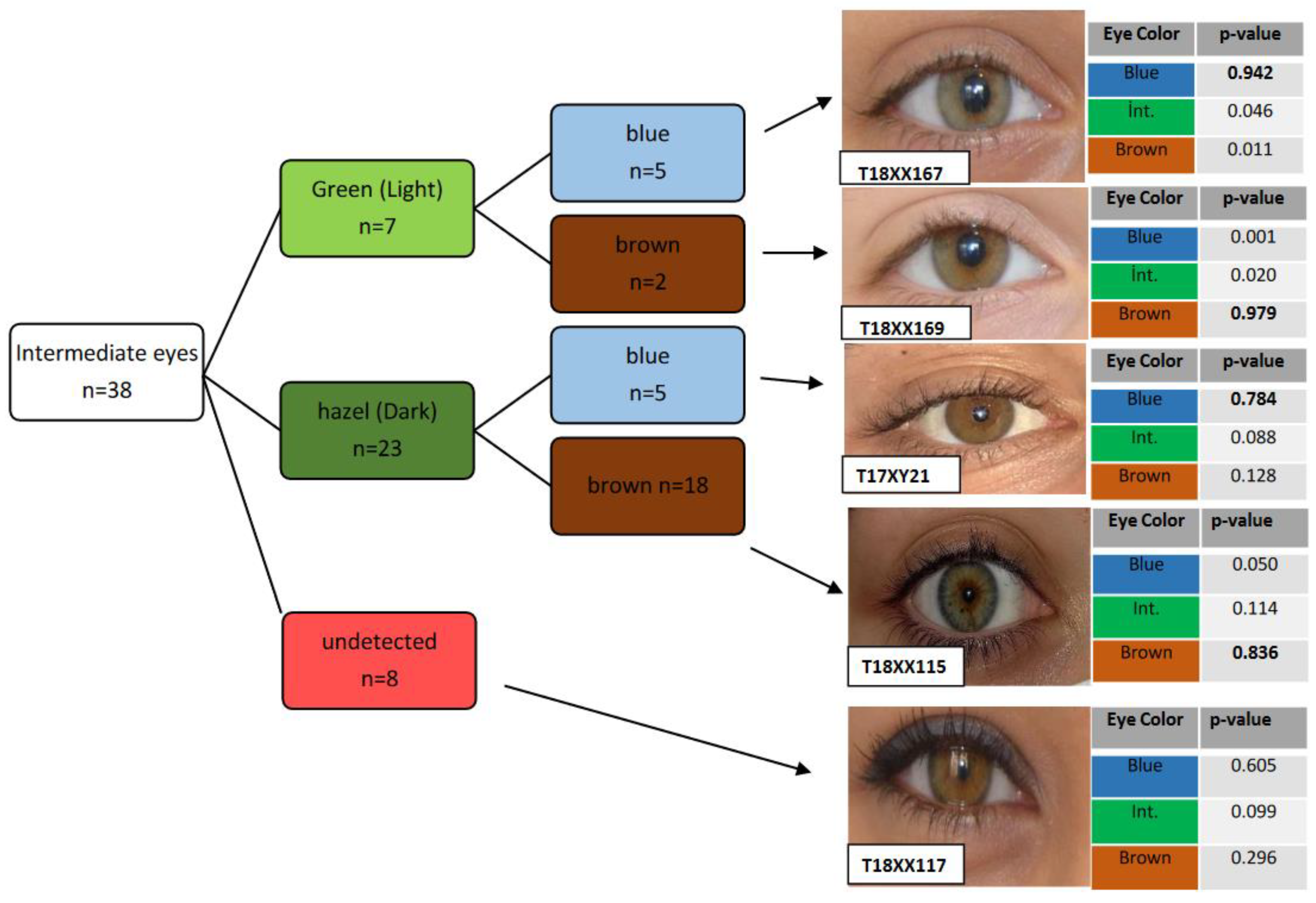
Eye colors that fall in-between the extremes of dark brown and light blue have varying amounts of pigment and areas without any pigment. This leads to the unique colors that we see in the form of green, hazel, and gray.
Eye color is a polygenic phenotypiccharacterand is determined by 2 distinct factors: the pigmentation of the eye's iris and the frequency-dependence of the scattering of light by the turbid medium in the stroma of the iris.
What Determines Eye Color?
What Causes Different Eye Colors
Homozygous And Heterozygous Human beings have two copies of every gene. One is inherited from the mother, and the other from the father. Homozygous means that two copies match or are dominant (denoted by two capital letters such BB) and heterozygous means that the two copies of the gene differ or recessive (denoted by two small letters, bb).
Dominant Eye Color Brown and green are dominant eye colors. There is a 75 to 95% chance of the baby getting brown or green eyes if both the parents have the same colored eyes.
Recessive Eye Color Blue is a recessive eye color. It’s highly unlikely for a baby to have blue eyes if both the parents have brown eyes.
Genotype The genotype is the gene combination for a given trait, which, in this case, is the eye color. The mother and father’s genotype will determine the eye color of the children.
Phenotype The phenotype is the physical appearance of the genotype, which in this case is the eye color.
In humans, the pigmentation of the iris varies from light brown to black, depending on the concentration of melanin in the iris pigment epithelium(located on the back of the iris), the melanin content within the iris stroma (located at the front of the iris), and the cellular density of the stroma. The appearance of blue, green, as well as hazel eyes results from the Rayleigh scattering of light in the stroma, a phenomenon similar to that which accounts for the blueness of the sky. Neither blue nor green pigments are ever present in the human iris or ocular fluid. Eye color is thus an instance of structural color and varies depending on the lighting conditions, especially for lighter-colored eyes.
The brightly colored eyes of many bird species result from the presence of other pigments, such as pteridines, purines, and carotenoids.Humans and other animals have many phenotypic variations in eye color.The genetics of eye color are complicated, and color is determined by multiple genes. So far, as many as 15 genes have been associated with eye color inheritance. Some of the eye-color genes include OCA2 and HERC2. The once-held view that blue eye color is a simple recessive trait has been shown to be incorrect. The genetics of eye color are so complex that almost any parent-child combination of eye colors can occur. However, OCA2 gene polymorphism, close to proximal regulatory region, explains most human eye-color variation.
Classification of colors
Iris color can provide a large amount of information about an individual, and a classification of various colors may be useful in documenting pathological changes or determining how a person may respond to various ocular pharmaceuticals. Various classification systems have ranged from a basic light or dark description to detailed gradings employing photographic standards for comparison. Others have attempted to set objective standards of color comparison.
As the perception of color depends on viewing conditions (e.g., the amount and kind of illumination, as well as the hue of the surrounding environment), so does the perception of eye color.
Eye colors range from the darkest shades of brown to the lightest tints of blue.
To meet the need for standardized classification, at once simple yet detailed enough for research purposes, Seddon et al. developed a graded system based on the predominant iris color and the amount of brown or yellow pigment present. There are three pigment colors that determine, depending on their proportion, the outward appearance of the iris: brown, yellow, and blue. Green irides, for example, have blue and some yellow. Brown irides contain mostly brown. Eye color in animals other than Homo sapiens are differently regulated.
For example, instead of blue as in humans, autosomal recessive eye color in the skink species Corucia zebrata is black, and the autosomal dominant color is yellow-green.
Which Are the Rarest Eye Colors?
Living in an English-speaking country, you might get the impression that there’s a pretty even mix of blue, hazel, and brown eyes in the population. However, across the rest of the planet, the ratios change wildly. The many shades of brown eyes are the overwhelming majority, while scientists are confident that they can trace blue eyes back to the same common ancestor with a specific mutation affecting eye color. Here are the overall percentages:
Brown eyes: 70-79%
Blue eyes: 8-10%
Hazel eyes: 5%
Gray eyes: 3%
Green eyes: 2%
Heterochromia (meaning the two eyes are different colors or there’s a patch of a different color in one eye): 1%
Red or violet eyes: under 1%
What Is Ocular Albinism?
The word “albinism” may make you think of light skin or hair. But albinism also can affect a person's eyes. When it does, it's called ocular albinism, a rare eye condition that happens much more often in boys and men than in girls or women.
The eyes of someone with ocular albinism may look different and act differently, and the person might need to wear special glasses or contact lenses.
But that person won’t lose his eyesight completely, and it won't get worse over time. In fact, as children who have it get older, their eyesight may get better. eResearch by navid ajamin -- autumn 2011
Causes of Ocular Albinism
People who have ocular albinism are born with it. In most cases, it happens because of a problem with a gene they inherit from their mothers. Women carry this gene but don’t usually have symptoms. Almost everyone who has the most common type, called type 1 or Nettleship-Falls, is male. About 1 in 60,000 males have this.
The other type of ocular albinism is much less common. Both parents carry the gene for it, and both boys and girls can be born with it. Their skin and hair color also can be lighter than that of other members of the family. If both parents have this gene, there’s a 1 in 4 chance their child will have it.
Symptoms of Ocular Albinism
The condition affects the retina and the nerves behind the eyes. The retina is a layer of tissue at the back of the eye that sends the brain signals about what a person sees. Things look blurry because the retina doesn’t develop the way it should. It can’t make a sharp image and the nerves behind the eyes can’t transmit a clear image to the brain.
Another symptom is the way the eyes look. Albinism keeps the body from making enough of a chemical called melanin, which gives eyes, skin, and hair their color. Most people with ocular albinism have blue eyes. But the blood vessels inside can show through the colored part (the iris), and the eyes can look pink or red.
People with ocular albinism usually don’t have the paler skin or hair seen in other kinds of albinism.
Living with Ocular Albinism
Bifocal glasses, prescription reading glasses, and contact lenses can help with vision. Some people also like using handheld magnifiers. And something as simple as having indoor lighting behind the shoulder instead of in front can help someone with ocular albinism see better.
Even though people who have this condition can be legally blind, they can still get a driver’s license in some states if they wear special glasses with small telescopes, called bioptics, mounted on them.
People with ocular albinism should be tested by an eye doctor and have exams at least once a year. The eye doctor can make sure the person has the right strength glasses or contact lenses to help him see better.
Children may have a hard time at school because they can’t see things on a blackboard or screen. Talk to your child’s school about large-print books, seating arrangements, and help in the classroom.
Your child’s eye doctor also may suggest:
Glasses or mini-telescopes
Computerized dictation programs and computer devices, such as video cameras, that can bring images closer
وبلاگ تخصصی عینک شامل مجموعه مطالب پزشکی است که اطلاعات مفیدی در رابطه با عینک , چشم، لنز، سلامتی چشم و راه های پیشگیری از بیماریهای چشمی، کنترل و درمان آن را در اختیار شما کاربر محترم می گزارد.









 وبلاگ تخصصی عینک شامل مجموعه مطالب پزشکی است که اطلاعات مفیدی در رابطه با عینک , چشم، لنز، سلامتی چشم و راه های پیشگیری از بیماریهای چشمی، کنترل و درمان آن را در اختیار شما کاربر محترم می گزارد.
