ابزار وبمستر

Lens aberration is a phenomenon that occurs when light rays passing through a lens do not converge at a single point, resulting in a distorted or imperfect image. It is caused by the limitations of the lens’s design and the way it interacts with light. There are several types of lens aberrations, each with its own unique characteristics and effects on the image.[1]

In optics, aberration is a property of optical systems, such as lenses, that causes light to be spread out over some region of space rather than focused to a point. Aberrations cause the image formed by a lens to be blurred or distorted, with the nature of the distortion depending on the type of aberration. Aberration can be defined as a departure of the performance of an optical system from the predictions of paraxial optics. In an imaging system, it occurs when light from one point of an object does not converge into (or does not diverge from) a single point after transmission through the system. Aberrations occur because the simple paraxial theory is not a completely accurate model of the effect of an optical system on light, rather than due to flaws in the optical elements.

An image-forming optical system with aberration will produce an image which is not sharp. Makers of optical instruments need to correct optical systems to compensate for aberration. Aberrations are particularly impactful in telescopes, where they can significantly degrade the quality of observed celestial objects. Understanding and correcting these optical imperfections are crucial for astronomers to achieve clear and accurate observations.[2] eResearch by Navid Ajamin -- autumn 2024


Minimizing Lens Aberrations [1]

Lens aberrations can be minimized by using high-quality lenses with advanced optical designs and specialized lens elements. Some techniques used to reduce aberrations include:

  • Aspherical lens elements: These have non-spherical surfaces to correct for spherical aberration and coma.
  • Apochromatic lenses: These use special glass types to minimize chromatic aberration.
  • ED (Extra-low Dispersion) glass: Reduces chromatic aberration by using glass with low dispersion properties.
  • Floating lens elements: These move within the lens barrel to correct for aberrations at different focusing distances.

Lens aberrations are inherent limitations of lenses, but they can be effectively minimized through careful lens design and the use of advanced optical technologies. Understanding the different types of aberrations and their effects on the image can help photographers and videographers select the appropriate lenses for their specific needs and achieve the desired image quality.

Types of Lens Aberrations [1]

Lens aberrations are imperfections in the way a lens focuses light. They can cause images to appear blurry, distorted, or have other defects. There are many different types of lens aberrations, but some of the most common include:

1. Spherical Aberration

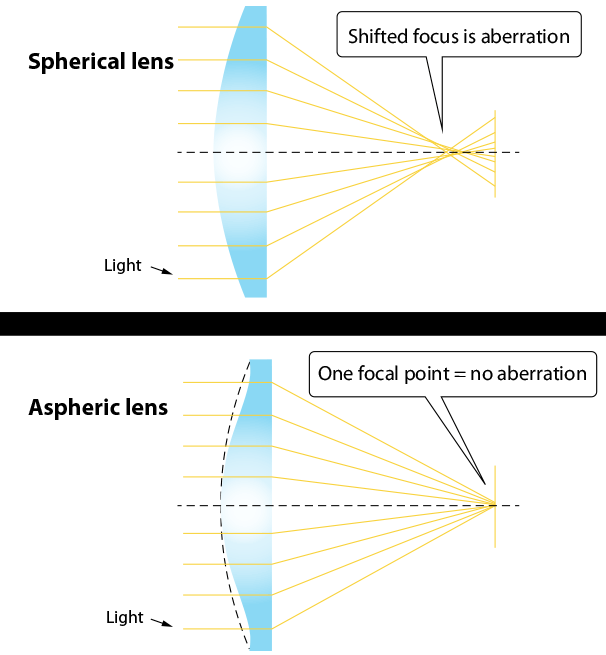
Spherical aberration occurs when light rays that pass through the center of a lens are focused at a different point than light rays that pass through the edges of the lens. This can cause images to appear blurry or have a “soft” focus. Spherical aberration is most noticeable in wide-angle lenses.

2. Coma

Coma occurs when light rays that pass through the center of a lens are focused at a different point than light rays that pass through the edges of the lens, but in this case, the difference in focus is not symmetrical. This can cause images to appear to have comet-like tails. Coma is most noticeable in off-axis objects.

3. Astigmatism

Astigmatism occurs when the lens is not perfectly spherical, causing light rays to focus at different points depending on their orientation. This can cause images to appear blurry or have double vision. Astigmatism is most noticeable in objects that are at an angle to the camera.

4. Field Curvature

Field curvature occurs when the focal plane of a lens is not flat, but instead is curved. This can cause images to appear blurry at the edges, while the center of the image is in focus. Field curvature is most noticeable in wide-angle lenses.

5. Distortion

Distortion occurs when the magnification of a lens is not uniform across the image. This can cause straight lines to appear curved or bowed. Distortion is most noticeable in wide-angle lenses.

6. Chromatic Aberration
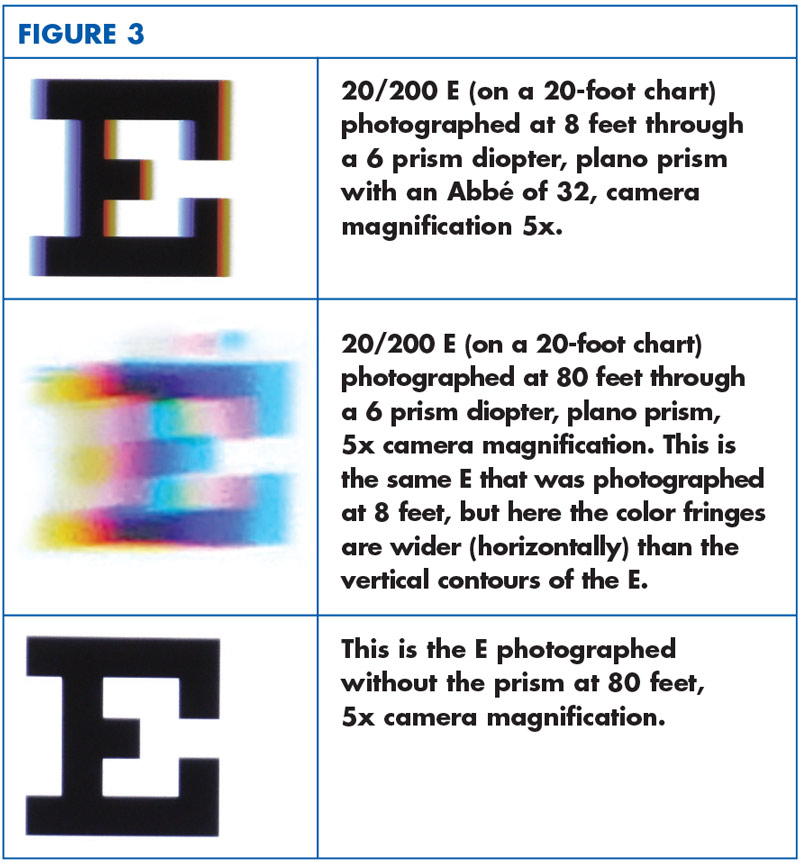
Chromatic aberration occurs when light of different colors is focused at different points. This can cause images to appear to have colored fringes around the edges of objects. Chromatic aberration is most noticeable in high-contrast images.

Lens aberrations are a common problem in photography, but they can be corrected using a variety of techniques. Some lenses are designed to minimize certain types of aberrations, and some cameras have built-in correction features. Additionally, software can be used to correct lens aberrations in post-processing.

Reference:

  1. sathee.prutor.ai/article/physics/physics-aberration-of-lens/#lens-aberration
  2. en.wikipedia.org/wiki/Optical_aberration
  3. hyperphysics.phy-astr.gsu.edu/hbase/geoopt/aberrcon.html
  4. phillipreeve.net/blog/lens-aberrations-explained-part-1
What is the purpose of aspheric lens?

You might feel self-conscious about your glasses and how they make you look, but aspheric lenses can help. With a flatter curve, there's less central thickness and less eye magnification. They also correct distortion and create a higher-quality image. Aspheric lenses can also improve your peripheral vision.

What Are Aspheric Lenses Used For?

You might want to choose aspheric lenses when you have a strong prescription or you experience dramatic refractive errors. Dramatic refractive errors mean you have significant problems with the way light focuses on your retina, which means you’ll need stronger corrective measures.

Relevant problems include conditions like:

  • Myopia, where objects in the distance are blurry
  • Hypermetropia, where objects close to you are blurry
  • Astigmatism, where objects near and far are blurry or distorted
  • Presbyopia, where you can’t see things close up as you get older

Your eye doctor might recommend lenses that are both aspheric and high-index. Where aspheric refers to the lens profile, high-index refers to lens material and thickness. The higher the index number, the thinner the lens.

It’s called a high-index lens because it has a high refractive index, which means light travels quickly through the material. The material bends light more efficiently, making it better at correcting high refractive errors.

An aspheric and high-index option means your lenses will be easier to wear with a strong prescription.

What is an Aspheric Lens ?

An aspheric lens or asphere (often labeled ASPH on eye pieces) is a lens whose surface profiles are not portions of a sphere or cylinder. In photography, a lens assembly that includes an aspheric element is often called an aspherical lens.

Aspheric lenses are also sometimes used for eyeglasses. Aspheric eyeglass lenses allow for crisper vision than standard "best form" lenses, mostly when looking in other directions than the lens optical center. Moreover, the reduction of the magnification effect of a lens may help with prescriptions that have different powers in the 2 eyes (anisometropia). Not related to the optical quality, they may give a thinner lens, and also distort the viewer's eyes less as seen by other people, producing better aesthetic appearance.[4]

An aspheric lens is designed for aberration correction. With the help of aspheric lens, the image formed is distortion free.

An aspheric lens is a lens whose surfaces profile neither a portion of a sphere nor of a circular cylinder. Since it is not spherical, the conventional processes no longer apply to making aspheric surfaces. This is why aspheric cost many times what spherical surfaces do.

In optics, a lens assembly that includes an aspheric element is often called an aspheric lens.

Benefit

The asphere's more complex surface profile can eliminate spherical aberration and reduce other optical aberrations compared to a simple lens. A single aspheric lens can often replace a much more complex multi-lens system. These lenses are small, lighter and in general, better than similar lenses which only employ spherical elements.

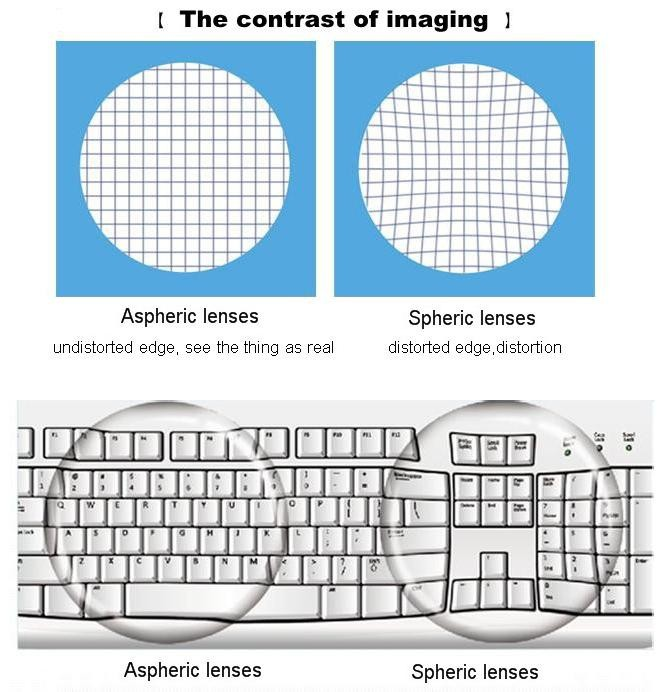
As magnifier, aspheric lens enhances image quality and minimizes distortion throughout the viewing area, it reduces distortion at wide angles, improves corner resolution. You can get more detail and high-resolution of the image.[1]

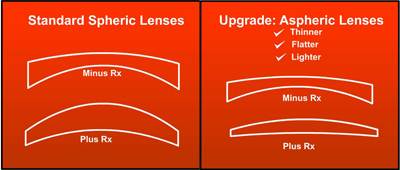
Asphericity allows lens designers to flatten a lens form in order to improve cosmesis, without sacrificing opical performance. The lens aberrations produced by using flattened lens forms are simply eliminated using the surface astigmatism of the aspheric design. While aspheric lenses do not provide better vision than best form lenses, they do provide equivalent vision in a flatter, thinner, and lighter lens.

Aspheric lenses allow lens designers to produce lenses that are considerably flatter, thinner, and lighter in weight than conventional best form lenses.

It is interesting to note that aspheric surfaces produce thinner lenses for two reasons:

  • Aspheric lenses generally use flatter front curves, which reduce the center thickness in plus lenses and the edge thickness in minus lenses.

  • The geometry of an aspheric surface also provides additional thickness reduction. Some aspheric lenses are even designed solely for cosmesis, and actually use more asphericity than what is optically required. This produces a thinner lens at the expense of reduced optical performance.

As with the base curve of a best form lens, the amount or degree of asphericity will depend upon the focal power of the lens.

Additionally, the surface (that is, front or back) upon which the asphericity has been applied will also make a difference:

  • Plus lenses. If asphericity is applied to the front surface of a plus lens, the surface will become flatter away from the center. If it is applied to the back surface, the surface will become steeper away from the center.
  • Minus lenses. If asphericity is applied to the front surface of a minus lens, the surface will become steeper away from the center. If it is applied to the back surface, the surface will become flatter away from the center.

Ideally, aspheric lenses should be optimized for each individual focal power. In practice, however, small ranges of powers are grouped upon common aspheric base curves—just like with best form lenses. Nevertheless, asphericity gives lens designers the freedom to optimize just about any base (front) curve for the chosen focal power—or range of powers. (Generally, flatter base curves are chosen for cosmesis.) [2]

An aspheric lens or asphere is a lens whose surfaces have a profile that is neither a portion of a sphere nor of a circular cylinder. In photography, a lens assembly that includes an aspheric element is often called an aspherical lens.

The asphere's more complex surface profile can eliminate spherical aberration and reduce other optical aberrations compared to a simple lens. A single aspheric lens can often replace a much more complex multi-lens system. The resulting device is smaller and lighter, and possibly cheaper than the multi-lens design.[3] eResearch by Navid Ajamin -- winter 2008

Related image

Traditional lenses have a bulgy, curved shape. Imagine the spherical surface of a ball. Aspheric lenses are designed with less curvature than their traditional counterparts. Think flatter and thinner. In both far and nearsighted prescriptions, aspheric lenses provide a slimmer profile and minimize eye distortion without compromising optical quality. Let’s take a look at how conventional lenses are designed for far and nearsighted prescriptions:

  • Lenses for farsightedness have a convex curve, meaning they are thicker in the center and thinner at the edges. The stronger the prescription, the more the middle of the lens bulges outwards.
  • Lenses for nearsighted prescriptions have a concave curve, meaning they are thinnest at the center of the lens and thickest at the edge.

For both types of prescriptions, aspheric lenses reduce the curve of the surface, either by minimizing the thickness of the center or the edges of the lens.

Benefits of Aspheric Lenses

  • Less bulging of the lens, giving you a sleeker profile
  • More frame options for individuals with strong prescriptions
  • More natural appearance of the eye (reduces the eye magnification that occurs with farsightedness and the smaller appearance of the eye that occurs with nearsightedness)
  • Lightweight (less material is used to make the lens)
  • Better peripheral vision
  • Higher image quality (more consistent magnification throughout the lens)

The surface radian of aspherical lens is different from that of ordinary spherical lens. In order to pursue the thinness of the lens, it needs to change the surface of the lens. Aspheric lens should be designed as flat as possible. However, the optical properties of flattened lenses, even if they are designed with aspheric surfaces, will decline rapidly. At the same time, the lens is lighter, thinner and flatter, and it still maintains excellent impact resistance, so that the wearer can use it safely.


Advantages of aspherical lenses:

  1. Optical advantages: reduce the aberration of the lens and make the vision clearer.
  2. Clear images can also be obtained at high luminosity: Although the spherical point focus lens is designed by the best base arc, the luminosity beyond + 7.00D-22.00D is not within the Cherning ellipse, and the aberration can not be eliminated. Only aspheric design can achieve better quality.
  3. It can make the lens flatter, thinner and more beautiful. The higher the lenticity of spherical lens, the worse the appearance. Aspheric lens can be designed with flat base arc, which not only makes the appearance beautiful, but also reduces the peripheral magnification. Let others see the wearer's eyes, will not change a lot in size.

Defects of aspherical lenses:

  1. Aspheric lens has a relatively small light area. When the eyeball rotates around, it will blur a little when looking at the outside through the lens edge, that is, the visual range of the line of sight becomes smaller.
  2. Human's eyeball is spherical. The eyeball rotates to the edge. Through aspheric lens, the object near the eye appears protruding.

Related image

Reference:

  1. greatwalloptical.com.hk
  2. opticampus.com
  3. novotech.net
  4. en.wikipedia.org/wiki/Aspheric_lens
  5. readers.com/blog/aspheric-lens-glasses
  6. hypoptics.com/about-us/resources/advantages-and-disadvantages-of-aspherical-lenses.htm
  7. webmd.com/eye-health/aspherical-lenses
nicetoview.blogfa.com
عینک eyewear وبلاگ تخصصی عینک شامل مجموعه مطالب پزشکی است که اطلاعات مفیدی در رابطه با عینک , چشم، لنز، سلامتی چشم و راه های پیشگیری از بیماریهای چشمی، کنترل و درمان آن را در اختیار شما کاربر محترم می گزارد.

Always Be Healthy
همیشه سلامت باشید

Navid Ajamin نوید عجمین
eMail: navid.aj@outlook.com
موضوعات وب
پیوندها

unicef for every child

شمارنده