People who cannot distinguish between certain colours and shades have a condition called colour vision deficiency (CVD), commonly known as colour blindness. Abnormal colour vision may vary from only a slight difficulty distinguishing among different shades of the same colour to the rare inability to distinguish any colours.
Most cases of CVD are inherited and the person is affected at birth. In some cases, however, the condition results from retinal or optic nerve diseases, the development of cataracts, certain medications, or aging. Diseases such as multiple sclerosis and diabetes can also cause colour vision disturbances.

What numbers do you see revealed in the patterns of dots below?
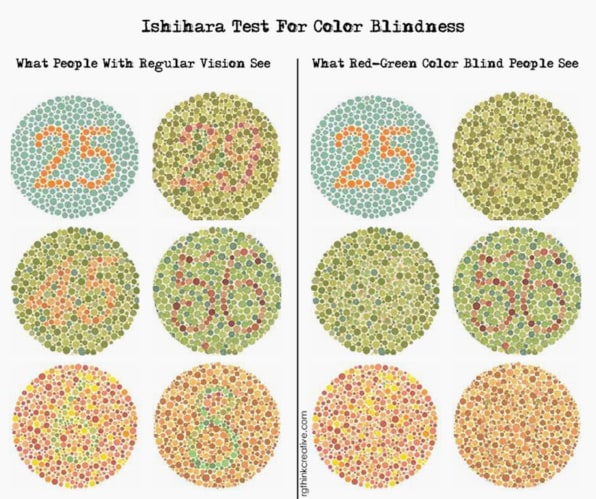
People with color deficiencies may have difficulty distinguishing certain colors (e.g., a red/green color deficiency means that reds and greens are more difficult to distinguish). But as this photo demonstrates, many other colors are just as distinguishable to a person with a color deficiency as to someone with normal color vision. eResearch by Navid Ajamin -- spring 2010
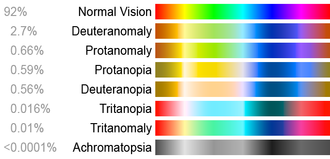
Below are the various types of colour deficiency.
WHO IS AFFECTED BY COLOUR VISION DEFICIENCY? In the inherited type of CVD, roughly 1 in 10 men have some degree of abnormal colour vision. This means that one of the three types of cones in their eyes is either faulty or missing altogether.
The condition is hereditary and sex-linked: fathers will pass the gene to their daughters (but not their sons) and mothers can pass it to all their children. However, because women can be unaffected carriers, men are at least 20 times more likely than women to develop colour vision problems.
Reference: eyeconx.com |



 وبلاگ تخصصی عینک شامل مجموعه مطالب پزشکی است که اطلاعات مفیدی در رابطه با عینک , چشم، لنز، سلامتی چشم و راه های پیشگیری از بیماریهای چشمی، کنترل و درمان آن را در اختیار شما کاربر محترم می گزارد.
