Metamorphopsia is vision dysfunction that causes objects — specifically straight lines — to appear warped, distorted or bent. Rather than a condition itself, metamorphopsia is a symptom. It can result from brain conditions or when there’s a problem with the macula, which is the center of the retina.

somesthetic distortions, including:
- Macropsia: Objects appear larger than they are
- Micropsia: Objects appear smaller
- Teleopsia: Objects seem farther away
- Pelopsia: Objects seem closer
- Metamorphopsia: Patients perceive their body or body parts as enlarging or shrinking
- Chromatopsia: Altered perception of colors
What is metamorphopsia in medical terms?
The term metamorphosis means to change a form or shape of nature into a completely different one. The prefix meta- means after or beyond, the combining form -morph/o means shape and the suffix -sis means an abnormal condition or process.
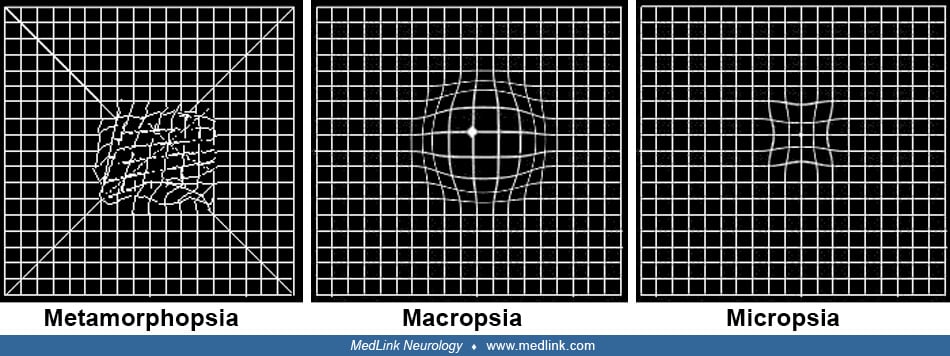
Metamorphopsia (“meta-more-FOP-see-ya”) is a medical term used to describe an abnormal visual perception in which images appear distorted. For example, straight lines appear curved or jagged. It is an important symptom of retinal disease. Metamorphopsia is not caused by the need for new glasses, cataract, glaucoma, or optic nerve damage. Metamorphopsia is a sign of a retinal problem. It is detected and monitored with an Amsler grid.
Metamorphopsia. Metamorphopsia (from Ancient Greek: μεταμορφοψία, metamorphopsia, 'seeing mutated shapes') is a type of distorted vision in which a grid of straight lines appears wavy or partially blank. In addition, metamorphopsia can result in misperceptions of an object's size, shape, or distance to the viewer.
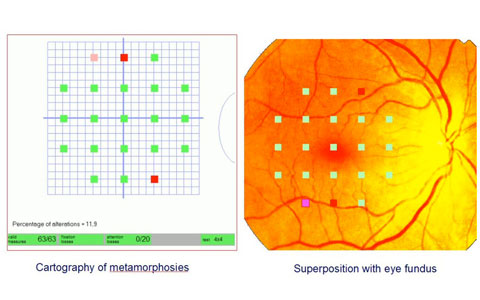
The retina is a thin layer of tissue at the back of the eye that uses light to create signals. Signals are sent to the brain through the optic nerve, and registered as an image. The macula is in the middle of the retina and gives us color vision, central vision and visual acuity.
When the retina or macula are affected by age, trauma or disease, metamorphopsia can result. It may affect one or both eyes and may only involve a portion of the vision in the affected eye. Metamorphopsia can potentially indicate the presence of a serious underlying medical cause.

What does metamorphopsia look like?
Metamorphopsia affects central vision. This means objects in your peripheral vision will likely appear normal, while things in front of you are distorted. While metamorphopsia is a symptom in itself, some signs to look out for include:
Objects that are normally straight appear curved or warped. Example: A light pole looking bent or “melted.”
Things that are normally flat appear rounded. Example: A frisbee looking like a bowl.
Borders on objects appear smudged or distorted. Example: The face of a watch looks like someone smeared the edges of it.
Objects change shape. Example: A rectangular door frame twists out of shape.
Things look disproportionately larger than normal (macropsia).
Things look disproportionately smaller than normal (micropsia).
If you experience any of the symptoms listed above without explanation, seek help from an eye doctor or medical professional.
How is metamorphopsia diagnosed?
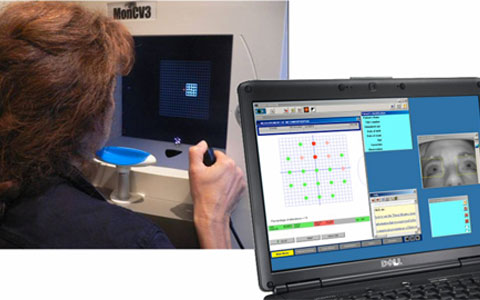
Your eye doctor may run a series of tests to determine whether you have metamorphopsia and how severe it is. The tests usually involve having the patient look at some type of chart and answering questions about what they see. Some tests used to measure metamorphopsia include:
Amsler grid
Amsler grid for metamorphopsia is the most well-known and the most commonly used test that doctors use. It involves looking at a box with equally spaced horizontal and vertical lines that create a grid. In the middle of the grid is a small dot.
To take the test, the patient must be wearing corrective lenses, reading glasses or whatever is required for them to have their best corrected vision. Then, they focus on the dot in the middle of the grid while covering one eye at a time. This part is especially important, as looking at the grid with both eyes can cause the good eye to compensate for the bad eye.
While focusing on the dot in the middle, the patient should pay attention to how the lines around the dot appear. If they still appear straight, metamorphopsia isn’t the problem. If these lines appear curved or warped, metamorphopsia may be the problem.

A patient’s perspective of metamorphopsia (B) compared to normal (A)
M-chart
The M-chart is more specific than the Amsler grid, but it isn’t used as often. It was created to help pinpoint the degree of metamorphopsia and whether the distortion is more present in horizontal or vertical lines.
The test has 19 dotted lines, starting with a straight line (zero degrees). The size and space between the dots that create the line gradually go from very fine (0.2 degrees) to coarse (2.0 degrees). Each line has a dot in the middle of it that the patient is supposed to focus on.
Starting with the straight, solid line, the patient will focus on the dot and tell the doctor whether the line looks curved in places or not. They do this for every line, from fine to coarse, until the line no longer looks distorted to the patient.
Once this is recorded, the doctor will turn the M-chart 90 degrees (making vertical lines horizontal or vice versa). The patient will perform the test again. eResearch by Navid Ajamin -- winter 2025
The farther the patient goes before the line no longer looks curved, the more severe their metamorphopsia is. It’s also recorded whether vertical or horizontal lines are affected more than the other.
Possible Causes
What are the most common causes of metamorphopsias?
Depending on why they happen, metamorphopsias can be a minor annoyance or a sign of serious problems. There are three main sources of metamorphopsias:
Refraction conditions and changes (most common).
Retinal changes and conditions.
Brain-related conditions (least common).
Metamorphopsia can be a symptom of a number of eye disorders involving the retina or macula.
Some of these conditions include the following:
- Age-related macular degeneration
- Epiretinal membrane and vitreomacular traction
- Posterior vitreous detachment
- Macular hole
Refraction conditions and changes
Your eye bends (refracts) light as it enters and passes through. That bending is supposed to focus light beams precisely on your retina. The more precise the focus, the clearer you see. Refractive errors are when that refracting doesn’t happen correctly. Examples include:
Strong or severe refractive errors like astigmatism.
A large difference in prescription strength needs between your eyes (anisometropia).
Cornea or lens shape changes/differences.
New corrective lenses (like eyeglasses or contacts), especially with bigger changes to how you see.
:max_bytes(150000):strip_icc()/GettyImages-705007087-7358fa86b9ce4600b507e88871ddb5f9.jpg)
Retinal changes and conditions
The retina at the back of your eye has a light-detecting layer of cells (photoreceptors). Part of how they work is due to the shape of your retina, which needs to lay flat against the layer underneath.
Wrinkles, holes or other retinal changes can cause metamorphopsias when they change the shape or position of your retina. Metamorphopsias are more severe when they happen in the macula, the part of your retina responsible for detecting color and fine details.
Your retina needs light to arrive with precise timing, so changes in your retina’s shape distort what you see if the light arrives too early. And if the changes in your retinal shape or position are severe, it can destroy the connections that let your retinas send light-related signals to your brain. When that happens, it can cause permanent vision loss or even blindness.
Retinal and retina-related conditions that can cause metamorphopsias include:
Age-related macular degeneration, especially the wet form.
Central serous retinopathy.

showing the visual perception Chorioretinopathy conditions like chorioretinitis.
Cystoid macular edema.
Diabetes-related retinopathy and diabetes-related macular edema (swelling).
Macular pucker.
Ocular migraine.
Retinal bleeding (hemorrhage).
Retinal tears or detachments.
Retinitis pigmentosa.
Uveitis, including choroid inflammation from infection-related conditions like presumed ocular histoplasmosis syndrome.
Reference:
- metrovision.fr
- en.wikipedia.org/wiki/Metamorphopsia
- gene.vision/knowledge-base/best-disease-for-patients
- scottpautlermd.com/metamorphopsia-visual-distortion
- allaboutvision.com/conditions/macula/metamorphopsia
- my.clevelandclinic.org/health/symptoms/metamorphopsia
- homework.study.com/explanation/define-the-following-medical-term-metamorphosis.html
- medsearchuk.com/when-kids-see-the-world-differently-insights-into-aiws-when-kids-see-the-world-differently-insights-into-aiws
 وبلاگ تخصصی عینک شامل مجموعه مطالب پزشکی است که اطلاعات مفیدی در رابطه با عینک , چشم، لنز، سلامتی چشم و راه های پیشگیری از بیماریهای چشمی، کنترل و درمان آن را در اختیار شما کاربر محترم می گزارد.
