Coma and astigmatism
Both image errors systemically appear on the regularly curved surfaces of spherical lenses and cannot be avoided in the first place. Coma is caused by obliquely inciding parallel rays of light on a spherical lens, astigmatism is caused by obliquely inciding diverging rays of light on the spherical surface.

Both errors can primarily be corrected by sophisticatedly combining several lenses and using aspheric lenses. The technical effort required for the correction is also reflected by the lens prices.
Coma (asymmetry error)
If a collimated ray ("parallel" light) incides on a lens not in parallel but at an angle to the optical axis, the ray will pass through the optic system in an unsymmetrical way due to different surface curvatures. In case of this imaging error, the rays are not bundled again in one image point. The focal points are therefore also not on the optical axis, but shifted towards the margin. In the image this error is visible as a drop-shaped, tail-like unilateral distortion of an image spot. The tail is always outwards in radial direction. Coma is caused by spherical aberration.
Assymetric error of lens (coma)
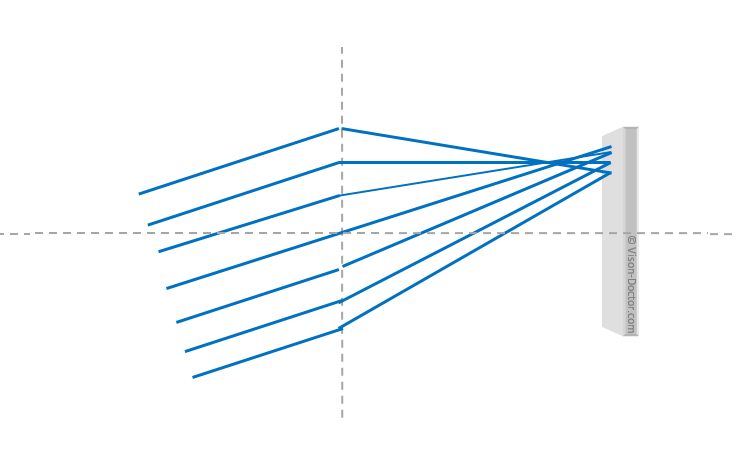
The user has the possibility to suppress this error by stopping down. The resulting artificial vignetting avoids rays inciding unsymmetrically on the lens close to the edge. Good lenses can avoid this error by means of a clever lens design.
Astigmatism (dotlessness)
If a diverging ray of light incides vertically on the lens surface and thus passes unsymmetrically to the optical axis, astigmatism occurs on spherical lens surfaces.
For easier examination, the inherently cone-shaped beam can be divided into two planes perpendicular to each other. (Both are approximately oriented towards the main beam which passes through the centre of the aperture, the meridional beam extends towards the optical axis, the sagittal beam is at right angles to it.
Meridional and sagittal ray
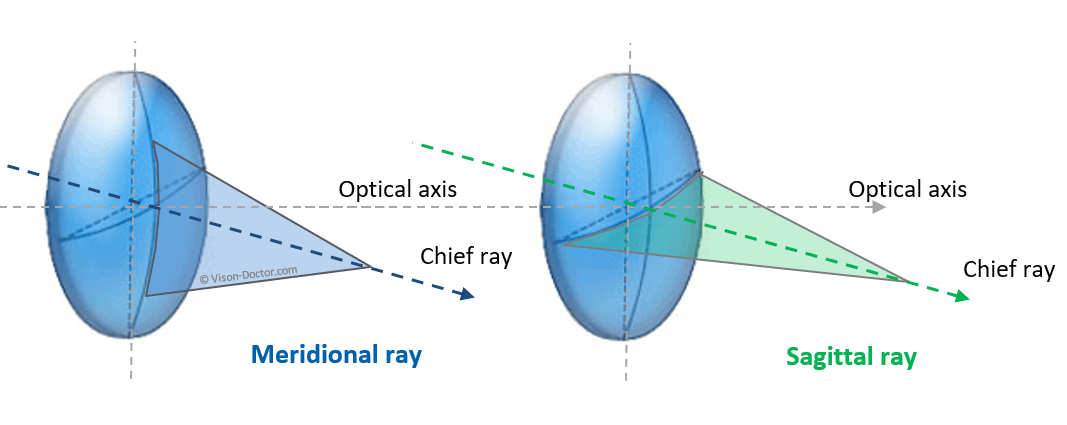
The reasons for astigmatism in case of oblique rays of light are the different local curvature radii of the latitudinal circles compared to the larger constant curvature radius of the meridional plane on the lens surface. The results are two different focal points and focal lengths for the different (meridional and sagittal) partial optical paths.
Creation of astigmatism
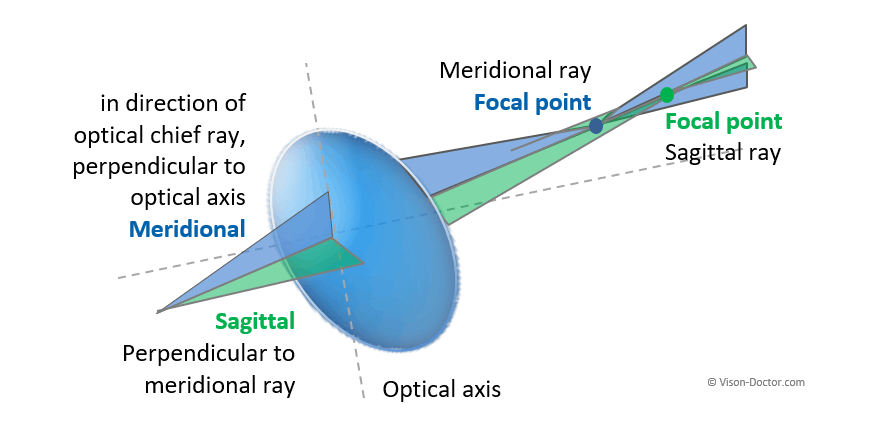
The image spot is no longer a dot, but reproduced in the form of two lines. It no longer seems to be sharp, but dotless. The camera image is not sharply focused for the viewer. This error can be suppressed by means of special lens types.
What causes coma in optics? eResearch by Navid Ajamin -- autumn 2024
Coma, so called because a point image is blurred into a comet shape, is produced when rays from an off-axis object point are imaged by different zones of the lens.
Coma is an aberration which causes rays from an off-axis point of light in the object plane to create a trailing "comet-like" blur directed away from the optic axis (for positive coma). A lens with considerable coma may produce a sharp image in the center of the field, but become increasingly blurred toward the edges. For a single lens, coma can be partially corrected by bending the lens. More complete correction can be achieved by using a combination of lenses symmetric about a central stop.

What are Aberrations of the Eye?
Described as small optical irregularities, aberrations are imperfections of the eye that result in light being unable to focus onto the retina effectively as well as defects in visual image. There are two types of aberrations; lower-order aberrations (0, 1st and 2nd order), and higher-order aberrations (3rd,4th…).
Higher Order Aberrations
Higher order aberrations (HOAs) of the eye are unable to be corrected by cylinder or spherical corrections and include spherical aberrations, coma and trefoil.
Coma Aberrations
Coma aberrations are caused when light rays from one edge of the pupil focuses before those from the opposing edge. Visually those with this type of aberration may experience smearing of an image so that images may appear to have a tail like a comet.
Trefoil Aberrations
Classed as a third order aberration, trefoil has a more minor affect on image quality compared to an equal amount of coma.
Spherical Aberrations
Spherical aberrations can cause halos surrounding point light sources and a reduction in contrast sensitivity.
It is thought that HOAs are responsible for individuals reporting complaints of glare, halos and reduction in contrast sensitivity following corneal refractive surgery. Approximately 90% of aberrations are caused by the cornea.
The eyes of young people tend to be less affected by higher order aberrations due to the partial compensation of aberration between the surface of the cornea and the internal optics. This mechanism has been found to work systematically for spherical aberrations and horizontal comas. As they are only affected by a small number of spherical aberrations and comas, young eyes are thought to approximate to an aplanatic optical system. However, as we age, more aberrations occur on average, specifically spherical aberrations as well as horizontal comas.

Lower Order Aberrations
Lower order aberrations include astigmatism, positive defocus (myopia), and negative defocus (hyperopia).
Astigmatism
Those with astigmatism have an eye that is shaped like a rugby ball than rather football. As a result, light tends to be focused at more than one place in the eye, causing blurry vision, eye strain and headaches. It is usually accompanied by short or long-sightedness.
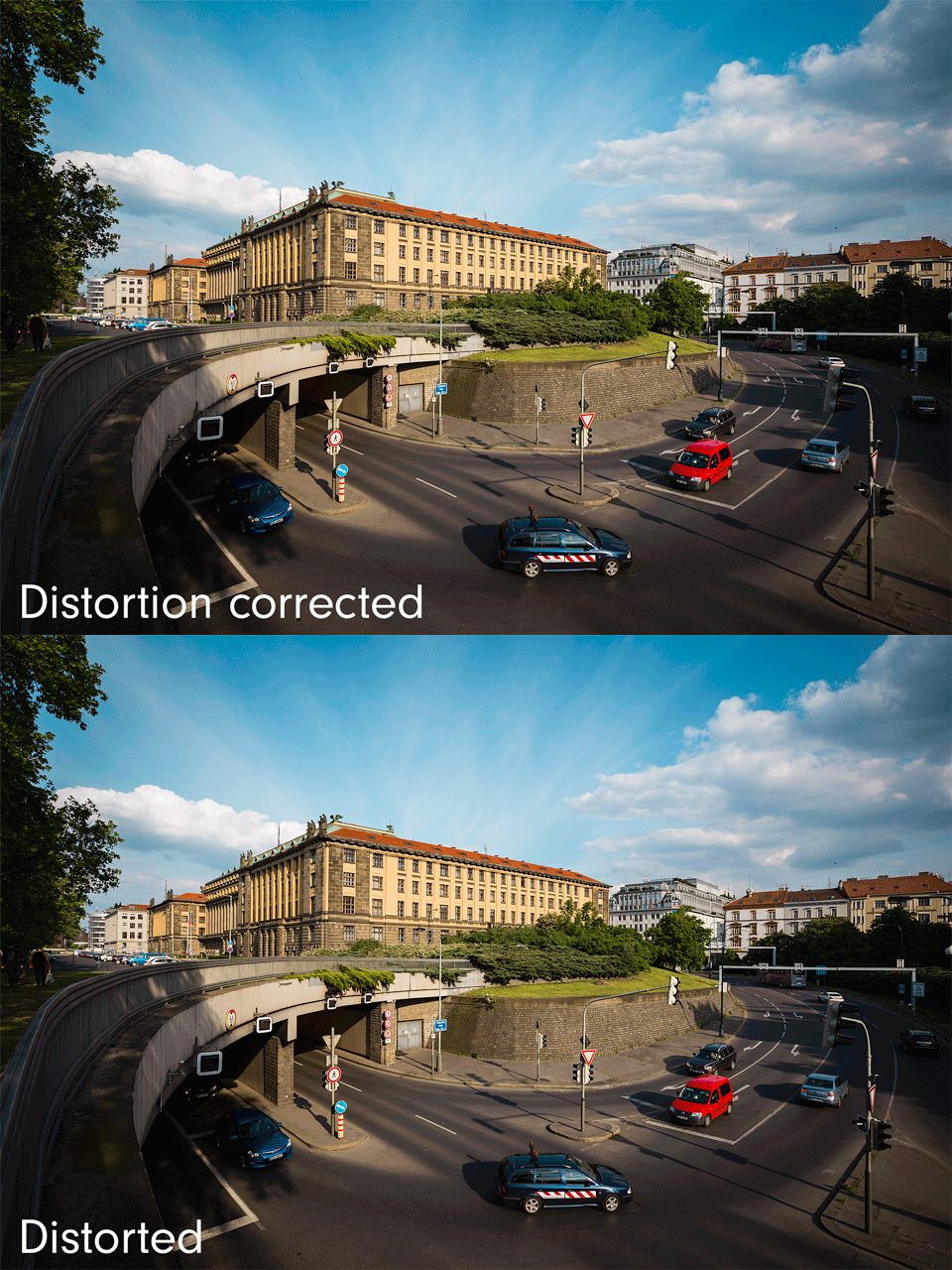
Reference:
- vision-doctor.com/en/optical-errors/coma-and-astigmatism.html
- news-medical.net/health/What-are-Aberrations-of-the-Eye.aspx
- exposuretherapy.ca/photography-guide/lens-aberrations-and-distortion
- visiondirect.com.au/optical-centre/eye-care/what-causes-distorted-vision
See also: Combining coma with astigmatism can improve retinal image over astigmatism alone
 وبلاگ تخصصی عینک شامل مجموعه مطالب پزشکی است که اطلاعات مفیدی در رابطه با عینک , چشم، لنز، سلامتی چشم و راه های پیشگیری از بیماریهای چشمی، کنترل و درمان آن را در اختیار شما کاربر محترم می گزارد.
