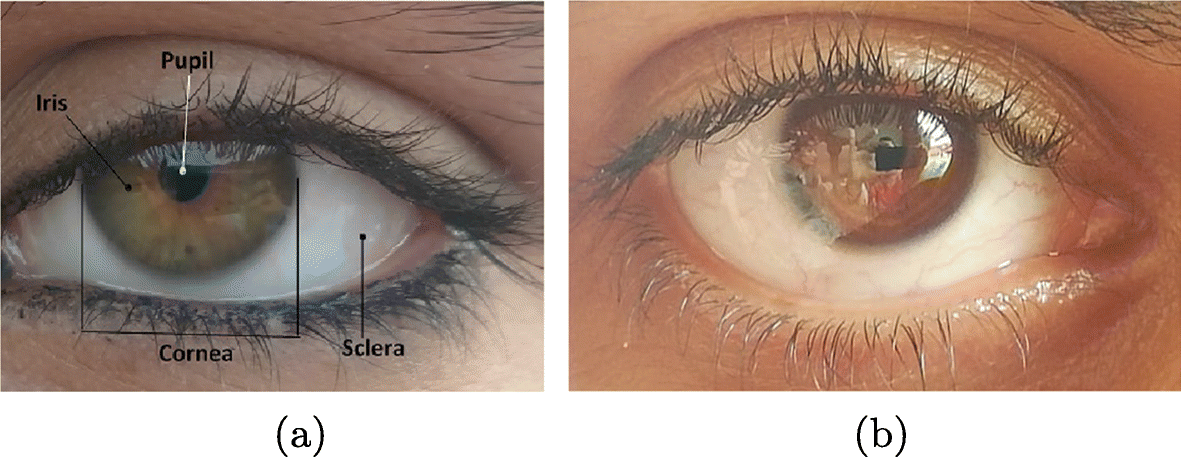
The cornea is the clear, front window of the eye. It helps focus light into the eye so you can see.
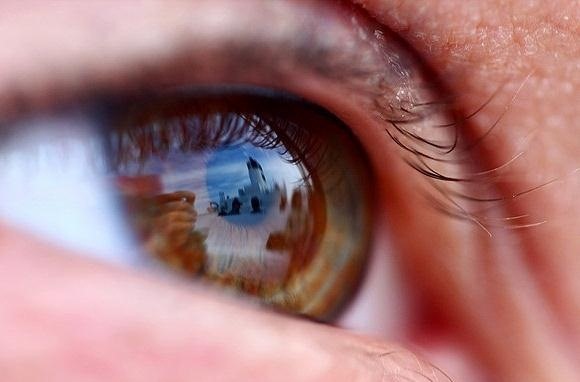
The cornea of the human eye acts as a mirror that reflects light from a person's environment.
These corneal reflections can be extracted from an image of the eye by modeling the eye-camera geometry as a catadioptric imaging system.
What is the principle of catadioptric system?
Catadioptric systems are devoid of aberrations, because the reflecting and refracting elements cancel out their aberrations. The lens and the mirrors of the system may be placed in the path of the incoming light, thus forming a full-aperture correcting system.
A catadioptric optical system is one where refraction and reflection are combined in an optical system, usually via lenses (dioptrics) and curved mirrors (catoptrics). Catadioptric combinations are used in focusing systems such as searchlights, headlamps, early lighthouse focusing systems, optical telescopes, microscopes, and telephoto lenses. Other optical systems that use lenses and mirrors are also referred to as "catadioptric", such as surveillance catadioptric sensors.

Corneal reflections. (a) View from the side onto the transparent reflective cornea. (b) A close view reveals the corneal limbus as the surface shape discontinuity, where the cornea dissolves into the white sclera. (c) The reflected office environment is clearly visible in the eye image. Diffuse iris reflections are superimposed with specular corneal reflections. (d) Focus on iris texture instead of corneal reflections. (e), (f) Examples of corneal images and corresponding (fisheye) images for different scenes.
As a result, one obtains the visual information of the environment and the relation to the observer (view, gaze), which allows for application in a number of fields. The recovered illumination map can be further applied to various computational tasks. This paper provides a comprehensive introduction on corneal imaging, and aims to show the potential of the topic and encourage advancement.
It makes a number of contributions, including a combined view on previously unrelated fields, an overview of recent developments, a detailed explanation on anatomic structures, geometric eye and corneal reflection modeling including multiple eye images, a summary of our work and contributions to the field, and a discussion of implications and promising future directions.
The idea behind this paper is a geometric framework to solve persisting technical problems and enable non-intrusive interfaces and smart sensors for traditional, ubiquitous and ambient environments. eResearch by Navid Ajamin -- winter 2024

The corneal reflections produced by different eye-head positions. The corneal reflection appears as a bright white dot, just to the right of the pupil (A). The relative positions of the pupil and the corneal reflection change when the eye rotates around its vertical (B) and horizontal (C) axes. This relationship does not change, however, when the head moves and the eye is stable (D).
What are the types of eye reflexes?
The reflexes of the eye include your:
- Pupillary reflexes
- Corneal reflexes
- Vestibulo-ocular reflex
- Oculocephalic reflex (doll’s eye reflex)
- Palpebral oculogyric reflex (Bell’s reflex)
What is the corneal reflection method?
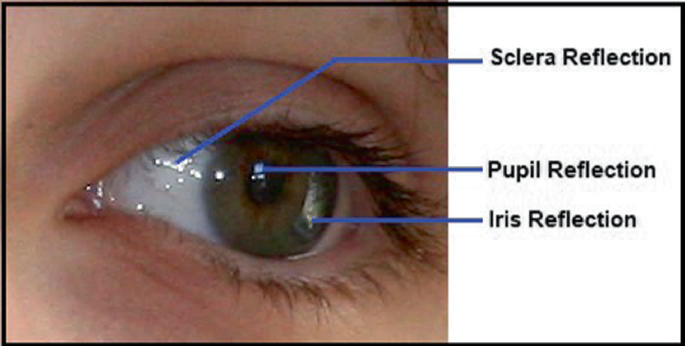
The reflection of light on the cornea (also known as glint) is tracked relative to the position of the pupil center, which allows us to estimate the point of gaze. This detection method is known as pupil-center corneal reflection (PCCR).
Reference:
- aao.org/education/image/corneal-anatomy
- azooptics.com/Article.aspx?ArticleID=668
- en.wikipedia.org/wiki/Catadioptric_system
- jstage.jst.go.jp/article/ipsjtcva/5/0/5_1/_article
- link.springer.com/article/10.1007/s11042-020-10409-3
- link.springer.com/chapter/10.1007/978-981-33-4084-8_32
- my.clevelandclinic.org/health/articles/24674-reflexes-of-the-eye
- tobii.com/resource-center/learn-articles/how-do-eye-trackers-work
- researchgate.net/figure/The-corneal-reflections-produced-by-different-eye-head-positions-The-corneal-reflection_fig1_246156704
- researchgate.net/figure/Corneal-reflections-a-View-from-the-side-onto-the-transparent-reflective-cornea-b-A_fig5_236627936
See also: Irregular corneal reflection
 وبلاگ تخصصی عینک شامل مجموعه مطالب پزشکی است که اطلاعات مفیدی در رابطه با عینک , چشم، لنز، سلامتی چشم و راه های پیشگیری از بیماریهای چشمی، کنترل و درمان آن را در اختیار شما کاربر محترم می گزارد.
