What are hormones?
Hormones are chemical messengers that control our body. You may have heard of hormones such as Thyroxine, Melatonin, Estrogen, Testosterone, Adrenaline and Insulin.
Hormones are produced by glands found in our brain and throughout our bodies. Glands such as the thyroid, pituitary and pineal glands, as well as the testes and ovaries. The system of hormones and glands and how they work is referred to as the endocrine system.
The various glands produce hormones using nutrients and substances found in the bloodstream. The hormones then travel around the body, via our bloodstream and other fluids to reach our organs and cells.
Once they arrive at the site of action, the hormones can stimulate our cells and organs to do a huge range of things, such as moderate stress, hunger, sleepiness, and mood. They also control our heart rate, growth and puberty.
Which hormones affect our eyes?
Everyone experiences hormonal changes throughout their lives, and these changes affect all parts of your body, including your eyes.
Sex hormones (namely estrogen) are the hormones most likely to affect our eyes and our vision. In particular, they play a big part in how dry or moist our eyes are and feel.
There are sex hormone receptors in our conjunctival goblet cells, lacrimal glands and meibomian glands. These three sites are responsible for making the three major components of our tears. These three components make up the three different layers of our tear film (oil layer, aqueous-watery layer and mucus layer). Disruption to one or more of these layers can result in dry eye symptoms.
Hormonal changes during puberty
During puberty, the large influx of hormones causes many changes in children. As their arms and legs lengthen, so do their eyeballs! A lengthening eyeball can result in blurry vision and myopia, or short-sightedness.
Myopia can be corrected with spectacles or contact lenses. And once the eyes have stopped changing, myopia can also be corrected with laser vision correction surgery.
There are techniques and treatments available to prevent or reduce this eyeball lengthening. This area of health care is referred to as Myopia Management or Myopia Control. The benefit of slowing down this growth-related change is that it could reduce how myopic a child or young adult may become. The more myopic a person is, the higher their risk of developing eye disease and loss of vision. So by reducing the level of myopia in an individual, we can reduce their risk of developing sight-threatening conditions later in life.
Hormonal changes in adult women
Women experience significant hormonal changes during pregnancy, breastfeeding, menopause and while on birth control medication. The hormones most involved are estrogen and progesterone.
Their changing levels can affect the eye’s oil glands, which can lead to dryness. Estrogen can also make the cornea less stiff with more elasticity, which can affect how light travels into the eye. The dryness and the change in refraction can cause blurry vision and can also make wearing contact lenses difficult.
Pregnancy and breastfeeding
With the changes that occur during pregnancy, women may experience blurry vision, light sensitivity, and even headaches and migraines due to fluctuating hormone levels and fluid retention. Most women’s vision will return to normal after giving birth and once breastfeeding has stopped.
However, if your vision doesn’t return to normal a couple of months after pregnancy, or it changes suddenly or drastically, seek medical advice sooner. It could be due to a more serious medical condition like diabetes or hypertension (high blood pressure).
Perimenopause and menopause
The hormonal shifts associated with perimenopause and menopause can also trigger vision changes.
Menopause occurs due to a drop in estrogen levels. This results in a drying out of tissues (skin, mucosal membranes, and hair). As tissues dry their structure can also change. This can affect vision by drying out the outer surfaces of the eye. A dry eye is a swollen eye and can lead to physical discomfort, contact lens intolerance, pain and blurred vision.
Menopause tends to occur in women aged 45 to 55 years of age, but perimenopause can begin a few months or a few years before that.
Menstruation
Although less common, some menstruating individuals may detect changes to their vision and eyes during the first week of menstruation. This correlates to an influx of estrogen at the beginning of the cycle which can cause blurred vision, trouble focusing, and watery eyes.
The dry eye that occurs as a result of hormonal changes can be treated. Artificial tears or lubricating eye drops are usually enough to resolve most people’s issues. Occasionally more involved treatments are required. But talking to your GP about ways to adjust your hormone levels medically, should have a positive impact on dry eye symptoms.
Thyroid Hormones and Vision
Thyroid hormones play a crucial role during the body’s development, including the development of the eyes. The thyroid gland is located at the base of our neck. It uses iodine from our food to produce two hormones: triiodothyronine (T3) and thyroxine (T4).
Thyroid eye disease develops when the body’s thyroid gland does not produce the correct amount or type of hormones.
One thyroid-related condition, called Graves’ disease, develops when there is an overproduction of thyroid hormones. About 30% of people with Grave’s disease also have eye-related changes such as; bulging eyes, puffy or retracted eyelids, light sensitivity, double vision, loss of vision, gritty, red or painful eyes.
Abnormal thyroid hormone levels can impact other aspects of eye development and disease.
Research has shown that people with higher levels of thyroxine (T4) are at increased risk of having age-related macular degeneration (AMD) and other retinal changes. And in another study, thyroid hormone levels appear to affect the ongoing development and regulation of the eye’s cones (cells responsible for your colour vision).
Male Hormones and Vision
Androgens are a group of hormones that control some male traits and reproductive activity. Testosterone and androstenedione are both androgens. Androgens are present in both males and females, even though they are often considered ‘male hormones’.
For example, women with polycystic ovary syndrome (PCOS) often have dry eyes due to excess androgen levels.
Androgens positively promote the function of meibomian glands and lacrimal glands. Meibomian glands make oil that prevents tears from evaporating, and the lacrimal glands produce the watery layer of our tears. So a drop in androgens can cause dry eyes by altering two important layers of the tear film.
Androgen levels drop with age, for both males and females. By the age of 50 years, it has dropped by about 30%, which is why dry eyes are more common as we age. Meibomian Gland Dysfunction is one of the most common causes of dry eye.
If you're bothered by dry eye, it's possible your hormones are to blame. These chemical messengers travel all over the body, so it's no surprise they can also affect your eyes.The chief ones are thyroid hormone, insulin, and sex hormones like estrogen. When you get treatment for your hormone problem, you'll get some relief from dry eye, too.
Can hormonal imbalance cause myopia?
During puberty, the large influx of hormones causes many changes in children. As their arms and legs lengthen, so do their eyeballs! A lengthening eyeball can result in blurry vision and myopia, or short-sightedness.
Sex Hormones

Sex hormones are hypothesized to play a role in the pathogenesis of various retinal disorders including age-related macular degeneration (AMD), central serous chorioretinopathy (CSCR), and retinitis pigmentosa.
Shifting levels of estrogen and progesterone can affect the glands in the eyes and eyelids, leading to dry, irritated eyes. Estrogen, the main sex hormone in women, can cause the cornea to become more elastic, changing the way light travels through the eye.
Similar to estrogen, testosterone impacts eye health. This hormone maintains the meibomian glands, which produce tears' oily layer to avoid dry eyes. Low testosterone levels in older men can induce dry eye syndrome and other vision difficulties.
Sex hormones are molecules produced by the gonads and to a small extent by the adrenal gland, which not only determine the primary and secondary sexual characteristics of an individual, differentiating man from woman, but also participate in the functioning of the various systems of the body. The evidence that many eye diseases differ in terms of prevalence between men and women has allowed us, in recent years, to carry out several studies that have investigated the association between sex hormones and the pathophysiology of eye tissues. Specific receptors for sex hormones have been found on the lacrimal and meibomian glands, conjunctiva, cornea, lens, retina, and choroid. This work summarizes the current knowledge on the role that sex hormones play in the pathogenesis of the most common ocular disorders and indicates our clinical experience in these situations. The aim is to stimulate an interdisciplinary approach between endocrinology, neurology, molecular biology, and ophthalmology to improve the management of these diseases and to lay the foundations for new therapeutic strategies.
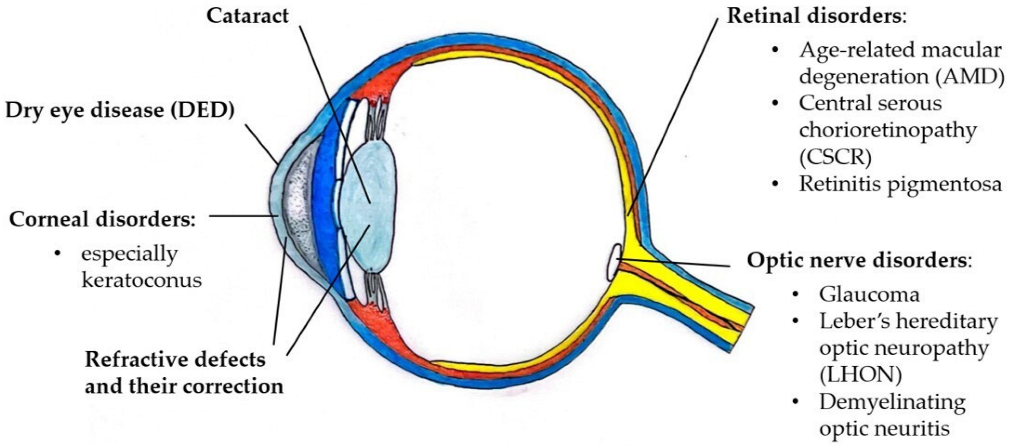
Changes in corneal thickness, curvature, and sensitivity have been observed during the menstrual cycle. In particular, an increase in corneal thickness was recorded during the ovulatory phase and the premenstrual luteal phase, respectively, at the peak of estrogen and progestogen. In fact, these sex hormones can induce water retention in the cornea such as to increase the central corneal thickness and sometimes cause changes in the curvature of the cornea, increase in intraocular pressure and visual disturbances. These effects are mainly determined by estrogens, which stimulate the activation of proteinases of the stromal matrix and collagenolytic enzymes, responsible for the biomechanical and structural alteration of the cornea. Estrogens also promote the deposition of hyaluronic acid and hydration, leading to an increase in central corneal thickness . Such biomechanical alterations are similarly found during pregnancy, especially during the third trimester.
If you're a woman, you're more likely to get dry eye, especially as you get older. That's because your levels of estrogen and other sex hormones change so much over your lifetime.For instance, you have a greater chance of getting dry eye when you go through menopause. It's a time of life when hormone levels, especially estrogen, go up and down.If you're pregnant, you're also more likely to get dry eye because of hormone changes. The same goes for women who take birth control pills and also wear contact lenses.
Estrogen and Its Effects on Vision
Women’s eye health depends on the production of estrogen. It protects the cornea, lens, and retina. However, estrogen fluctuations during menopause can cause dry eye syndrome and other vision issues. To diagnose and treat hormonally-related vision disorders, women must undergo regular eye exams, especially after menopause.
Testosterone and Its Effects on Vision
Similar to estrogen, testosterone impacts eye health. This hormone maintains the meibomian glands, which produce tears’ oily layer to avoid dry eyes. Low testosterone levels in older men can induce dry eye syndrome and other vision difficulties.
Thyroid Hormones and Their Effects on Vision
Eye muscle function depends on the activity of thyroid hormones. Double vision and bulging eyes can result from thyroid hormone imbalances such as hyperthyroidism or hypothyroidism. Thyroid illnesses require regular eye exams to detect hormone-related vision issues before they worsen.
Cortisol and Its Effects on Vision
Cortisol, known as the “stress hormone”, controls ocular pressure. Chronic stress or adrenal diseases can cause high cortisol levels, which can contribute to the likelihood of glaucoma and other eye issues. People experiencing high levels of stress should undergo regular eye exams to determine cortisol-related eye disorders early and prevent long-term visual impairment.
Insulin and Its Effects on Vision
Insulin regulates blood sugar, which has an impact on eye health. Insulin imbalances, especially in diabetics, can cause diabetic retinopathy and other vision issues. Diabetics must have regular eye exams to detect and treat insulin-related vision problems before they worsen.
The Role of an Optometrist in Maintaining Eye Health
In maintaining eye health, the role of an optometrist cannot be overstated. Scheduling a visit with them is crucial to ensuring your overall vision health is in check, detecting hormone-related vision problems and providing necessary interventions. Additionally, they provide eyeglasses and contact lenses prescriptions to help correct vision problems.
Reference:
- webmd.com/eye-health/dry-eye-hormones
- wefixeyes.co.nz/articles/how-do-hormones-affect-our-eyes
- eonvisioncare.com/blog/eye-care/how-hormones-affect-your-vision-and-eye-health
- ncbi.nlm.nih.gov/pmc/articles/PMC8949880 Sex Hormones and Their Effects on Ocular Disorders and Pathophysiology
 وبلاگ تخصصی عینک شامل مجموعه مطالب پزشکی است که اطلاعات مفیدی در رابطه با عینک , چشم، لنز، سلامتی چشم و راه های پیشگیری از بیماریهای چشمی، کنترل و درمان آن را در اختیار شما کاربر محترم می گزارد.
