Video Eyewear is a very young field. It was born out of a merging of the old HMD industry, and the need for far smaller, more lightweight devices for augmented reality applications.
Video eyewear basically consists of a display system as light as a pair of sunglasses - maybe five to ten ounces total - that slips over the eyes, delivering sterioscopic displays of a film, or virtual environment to the viewer, along with synchronous sound playback to the ears. eResearch by Navid Ajamin -- spring 2007

To maintain contact with the outside world and prevent total immersion, video eyewear equipment usually maintains a distance from the eyes of two or three centimeters - just enough so the wearer can see over the top of the display if they have to.
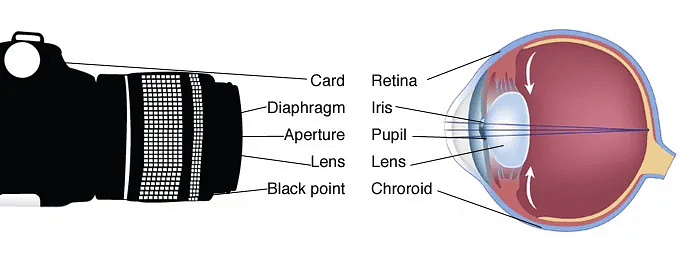
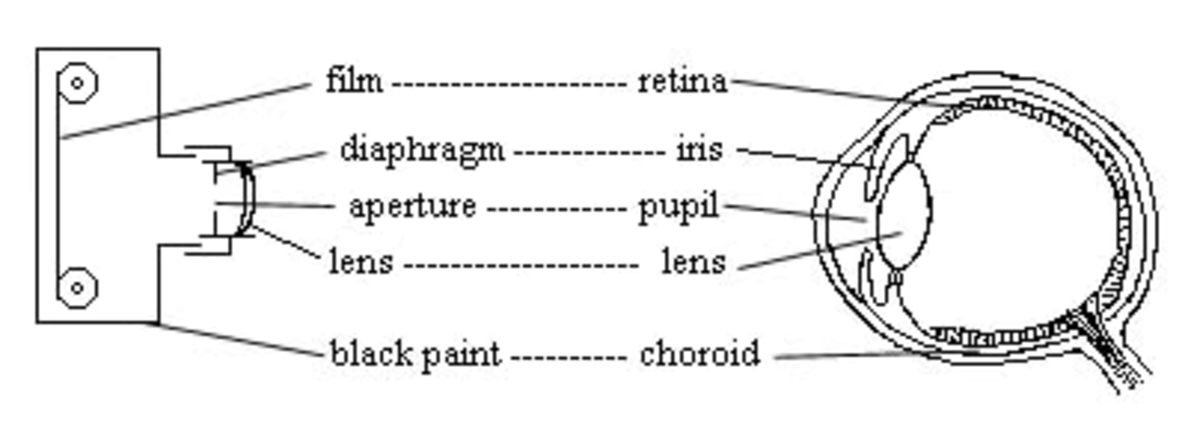
The eye can be compared to a camera.
The cornea is the transparent, curved front layer of the eye, where light is first focused before it passes through the pupil.
The pupil, behind the cornea, is a hole in the colored membrane called the iris. Tiny muscles in the iris change the size of the pupil – like the aperture apparatus of a camera – to control the amount of light getting into the back of the eye.
There is a small, powerful lens behind the pupil which changes shape, based on the pull of muscles in the eye, in order to further focus the light on the retina, which is a light-sensitive membrane lining the inside back of the eye.(Incidentally, cataracts are a deterioration of the human lens, and cataract surgery removes this lens and replaces it with a clear, artificial one.)
Like film in an older camera or sensors in a digital camera, the retina is a light-sensitive surface where light energy from the outside world is displayed and initiates a reaction that leads to the formation of an image. In a camera, film must be exposed to chemicals in order to permanently fix the image for future print processing. In the retina, millions of microscopic photoreceptor cells, known as rods and cones, are activated by light and, through a biochemical process, turn light into electric impulses. These impulses travel the optic nerve (a cable built of thousands of nerve fibers) to the visual processing center of the brain, where they are interpreted as vision.
The biochemical process of transforming light into electricity that occurs in the retina (known as phototransduction) makes it the most metabolically active tissue in the body. Just as the chemicals used to process film — or to print from film onto materials such as paper — have to be regularly removed and refreshed in order to maintain the purity of the image-making process, the protein-fat biological waste generated by photoreceptors has to be constantly removed, and fresh nutrients have to be resupplied to the rods and cones. This cleanup and nutrient supply process is carried out by the retinal pigment epithelium (RPE), a single layer of tightly joined cells that lies behind the photoreceptors and in front of Bruchs membrane, and the capillary-rich choroid. Specialized white blood cells, called macrophages, aid in the cleanup.
While scientists are still learning about the variety of factors that can disrupt this cleanup-and-refresh process, the common byproduct of disruption is a druse — a clump of proteins and fats that can grow and connect to other drusen. When drusen become so large that they cannot be cleared away by macrophages, they can push the RPE and photoreceptors away from the back of the eye, creating distortion in the images formed in the brain.
Reference:
- macular.org/about-macular-degeneration/what-is-macular-degeneration/disease-overview/how-the-eye-works-as-a-camera
- collegedunia.com
 وبلاگ تخصصی عینک شامل مجموعه مطالب پزشکی است که اطلاعات مفیدی در رابطه با عینک , چشم، لنز، سلامتی چشم و راه های پیشگیری از بیماریهای چشمی، کنترل و درمان آن را در اختیار شما کاربر محترم می گزارد.
