The Eye
The eye is stage one of the human vision system.
Here is a diagram of the human eye:
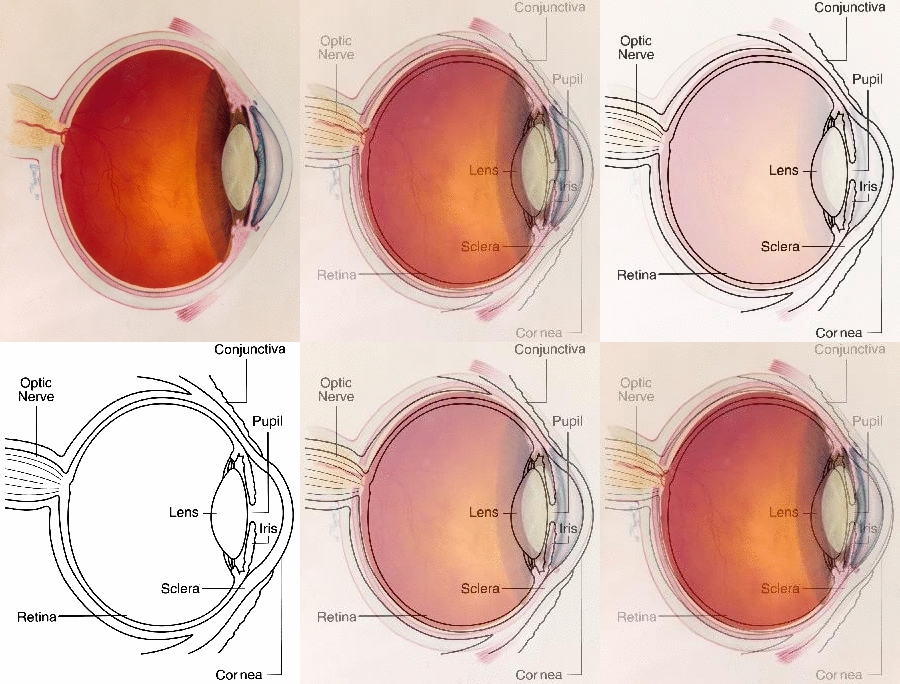
Light first passes through the iris. The iris is what adjusts for the amount of light entering the eye - an auto-brightness adjuster. This is so no matter how much light the eye sees, it tries to adjust the eye to always gather a set amount.
Note that if the light is still too bright, you will feel naturally compelled to cover your eyes with your hands.
Light then passes to the lens, which is stretched and compressed by muscles to focus the image. This is similar to auto-focus on a digital camera.
Notice how the lens inverts the image upside-down?
With two eyes creates stereo vision, as they do not look in parallel straight lines. For example, look at your finger, then place your finger on your nose - see how you automatically become cross eyed?

The angle of your eyes to each other generates ranging information which is then sent to your brain.
Note: this however is not the only method the eyes use to generate range data.

Cones and Rods
The light then goes into contact with special neurons in the eye (cones for color and rods for brightness) that convert light energy to chemical energy. This process is complicated, but the end result is neurons that fire in special patterns that are sent to the brain by way of the optical nerve. Cones and Rods are the biological versions of pixels. But unlike in a camera where each pixel is equal, this is not true for the human eye.

Rods and Cones within Eye
What the above chart shows is the number of rods and cones in the eye vs location in the eye. At the very center of the eye (fovea = 0) you will notice a huge number of cones, and zero rods. Further out from the center the number of cones sharply decrease, with a gradual increase in rods. What does this mean? It means only the center of your eye is capable of processing color - the information from the rods going to your brain is significantly higher!
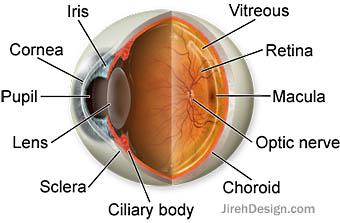
Note the section labeled optic disk. This is where the optic nerve attaches to your eye, leaving no space left for light receptors. It is also called your blind spot.
Compound Eyes
Compound eyes work in the same way the human eye above works. But instead of rods and cones being the pixels, each individual compound eye acts as a pixel. Unlike popular folk-lore, the insect doesnt actually see hundreds of images. Instead it is hundreds of pixels, combined.
Compound Eye Compound Eye Close-up
An robot example of a compound eye would be getting a hundred photoresistors and combining them into a matrix to form a single greyscale image.
What advantage does a compound eye have over a human eye? If you poke a human eye out, his ability to see (total pixels gathered) drops to 50%. If you poke an insect eye out, it will still have 99% visual capability. It can also simply regrow an eye.

Optic Nerve 'Image Processing' eResearch by Navid Ajamin -- summer 2008
Most people dont realize how jumbled the information from the human eye really is. The image is inverted from the lens, rods and cones are not equally distributed, and neither eye sees the exact same image!
This is where the optic nerve comes into play. By reorganizing neurons physically, it can reassemble an image to something more useful.
Optic Nerve
Notice how the criss-crossing reorganizes the information from the eyes - that which is seen on the left is processed in the right brain, and that which is seen on the right is processed in the left brain. The problem of two eyes seeing two different images is partially solved. Also interesting to note, there are significantly fewer neurons in the optic nerve then there are cones and rods in the eye. Theory goes that there is summing and averaging going on of 'pixels' that are in close proximity in the eye.
What happens after this is still unknown to science, but significant progress has been made.
Brain Processing
This is where your brain 'magically' assembles the image into something comprehendable. Although the details are fuzzy, it has been determined that different parts of your brain process different parts of the image. One part may process color, another part detecting motion, yet another determining shape. This should give you clues to how to program such a system, in that everything can be treated as seperate subsystems/algorithms.
Reference: societyofrobots.com
 وبلاگ تخصصی عینک شامل مجموعه مطالب پزشکی است که اطلاعات مفیدی در رابطه با عینک , چشم، لنز، سلامتی چشم و راه های پیشگیری از بیماریهای چشمی، کنترل و درمان آن را در اختیار شما کاربر محترم می گزارد.
