There's no proven technique for preventing presbyopia. The gradual decline of the ability to focus on near objects affects everyone. However, you can help protect your vision with these steps: Get regular eye examinations.[4]
There are five types of presbyopia: eResearch by Navid Ajamin -- spring 2011
- Incipient presbyopia. This is the very earliest stage, when it may be a bit more difficult to read small print.
- Functional presbyopia. This occurs when you begin to notice more problems with near sight.
- Absolute presbyopia. If you have this type, your eyes cannot focus on near objects at all.
- Premature presbyopia. This term is used when presbyobia occurs before the age of 40 years.
- Nocturnal presbyopia. When this occurs, focusing on near objects is particularly difficult in low light conditions.[6]

Nothing can be done to prevent presbyopia. It is an inevitable part of aging. However, people who do a lot of close visual work, such as working with a computer or intensive reading, may develop presbyopia earlier than others. If you do close work, take a 10-minute break every one to two hours to relieve strain on the eyes. Allow your eyes to focus on objects at a middle or long distance away to give your eyes a rest from close focusing. Be sure to use bright lighting when reading to help your eyes focus.[1]
As we age, the lens of the eye becomes increasingly inflexible, making it harder to focus clearly on near objects. This is called presbyopia. ... Beginning early in life — perhaps as early as age 10 — our lenses gradually stiffen and begin to lose the ability to change shape.
 Presbyopia is a condition in which the lens of the eye loses its ability to focus, making it difficult to see objects up close.
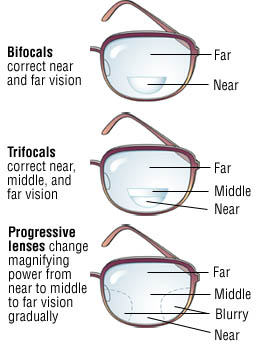
Presbyopia cannot be cured. Instead, prescription glasses, contact lens, reading glasses, progressive addition lenses, or bifocals can help correct the effects of presbyopia. Bifocals are often prescribed for presbyopia. Bifocals are eyeglasses that have two different prescriptions in one spectacle lens.[3]
The cause of presbyopia is lens hardening by decreasing levels of α-crystallin, a process which may be sped up by higher temperatures.
In optics, the closest point at which an object can be brought into focus by the eye is called the eye's near point. A standard near point distance of 25 cm is typically assumed in the design of optical instruments, and in characterizing optical devices such as magnifying glasses.
There is some confusion over how the focusing mechanism of the eye works. In the 1977 book, Eye and Brain, for example, the lens is said to be suspended by a membrane, the 'zonula', which holds it under tension. The tension is released, by contraction of the ciliary muscle, to allow the lens to become more round, for close vision. This implies the ciliary muscle, which is outside the zonula, must be circumferential, contracting like a sphincter, to slacken the tension of the zonula pulling outwards on the lens. This is consistent with the fact that our eyes seem to be in the 'relaxed' state when focusing at infinity, and also explains why no amount of effort seems to enable a myopic person to see farther away.

Mobile Phones Causing Presbyopia At An Early Age pc-tablet.com
The ability to focus on near objects declines throughout life, from an accommodation of about 20 dioptres (ability to focus at 50 mm away) in a child, to 10 dioptres at age 25 (100 mm), and levels off at 0.5 to 1 dioptre at age 60 (ability to focus down to 1–2 meters only).
The expected, maximum, and minimum amplitudes of accommodation in diopters (D) for a corrected patient of a given age can be estimated using Hofstetter's formulas:
expected amplitude (D) = 18.5 - 0.3 × (age in years),
maximum amplitude (D) = 25 - 0.4 × (age in years),
minimum amplitude (D) = 15 - 0.25 × (age in years).
Causes, incidence, and risk factors
The lens of the eye needs to change its length or shape to focus on smaller objects, or objects that get closer or farther away. This is called the elasticity of the lens. This elasticity is slowly lost as people age. The result is a slow decrease in the ability of the eye to focus on nearby objects.
People usually notice the condition at around age 45, when they realize that they need to hold reading materials further away in order to focus on them. Presbyopia is a natural part of the aging process and it affects everyone.

Presbyopia causes the following symptoms:
- Words appear blurred at a reading distance that used to be comfortable.
- Reading material or other objects must be held farther away from your eyes to gain clarity or see details.
- Brighter light is needed to see clearly (bright light constricts the pupils, which changes the focus of the light on the retina).
- You have difficulty reading late at night, or when you are tired or stressed.
- Your eyes become uncomfortable, or you become tired or drowsy when doing close work because of the strain of eye muscles working to change the lens shape.
- You may have headaches as a result of muscle tension.
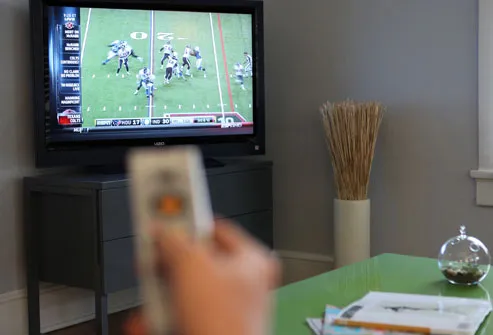
Presbyopia eventually affects everyone, even people who are already farsighted (hyperopic) or nearsighted (myopic). Because people who are farsighted already need to work when focusing on near objects, they may experience presbyopia a little earlier in life. People who are nearsighted will still experience presbyopia when wearing their corrective glasses or contact lenses for distance. However, for looking at objects or letters closer to them, they will likely be able to see quite clearly when they take off their glasses. This is where the term "nearsighted" comes from.[5]
You can’t prevent or reverse presbyopia with natural treatments. However, quitting smoking (if you smoke) and upping your intake of vitamins A, C, and E may improve your eye health.
Presbyopia is a progressive loss of your ability to see clearly at a close distance. It’s a natural result of the aging process.
Presbyopia progresses as the lenses inside your eyes lose elasticity. The speed of progression, the severity of visual symptoms, and the exact age of onset for presbyopia vary. However, the degeneration of the lens that leads to presbyopia is a natural part of the aging process.
When you’re young, the lens in your eye is flexible and relatively elastic. It can change its length or shape with the help of a ring of tiny muscles that surround it.The muscles that surround your eye can easily reshape and adjust your lens to accommodate both close and distant images.
With age, your lens loses flexibility and begins to stiffen. As a result, your lens becomes unable to change shape and constricts to focus on close images.With this hardening of your lens, your eye gradually loses its ability to focus light directly onto your retina.
You’re at a higher risk of premature presbyopia if you have: [7]
- anemia, which is a lack of enough normal blood cells
- cardiovascular disease
- diabetes, or difficulty metabolizing blood sugar
- hyperopia, or farsightedness, which means you have a greater difficulty seeing objects nearby than objects that are far away
- multiple sclerosis, which is a chronic illness that affects your spine and brain
- myasthenia gravis, which is a neuromuscular disorder that affects your nerves and muscles
- eye trauma or disease
- vascular insufficiency, or poor blood flow
Some prescription and over-the-counter drugs can reduce your eye’s ability to focus on close images. Taking the following drugs can put you at a higher risk of premature presbyopia:
- alcohol
- antianxiety drugs
- antidepressants
- antihistamines
- antipsychotics
- antispasmodics
- diuretics
Other factors that may put you at a higher risk of premature presbyopia are:
- being female
- having intraocular surgery, or surgery done on the inside of the eye
- eating an unhealthy diet
- having decompression sickness, or “the bends,” which results from rapid decompression and typically occurs in scuba divers that surface too quickly
The American Academy of Ophthalmology recommends that adults have a complete eye exam every:
- Five to 10 years under age 40
- Two to four years between ages 40 and 54
- One to three years between ages 55 and 64
- One to two years beginning at age 65
Reference:
- sparkpeople.com
- wikipedia.org/wiki/Presbyopia
- my.clevelandclinic.org
- healthline.com
- health.harvard.edu
- patient.info/eye-care/long-sight-hypermetropia/age-related-long-sight-presbyopia
- healthline.com/health/presbyopia#risk-factors
 وبلاگ تخصصی عینک شامل مجموعه مطالب پزشکی است که اطلاعات مفیدی در رابطه با عینک , چشم، لنز، سلامتی چشم و راه های پیشگیری از بیماریهای چشمی، کنترل و درمان آن را در اختیار شما کاربر محترم می گزارد.
