Spectacle vs. Contact Lens RX and Prescription Terminology
Glasses sit about 12 millimeters from the eye, while contacts sit directly on the eye surface. These 12 millimeters make a world of difference and can dramatically change the prescriptions between the two. Also, contact lens prescriptions require more specifications than glasses.
What is the difference between contact rx and glasses rx?
Your Two Different Prescriptions
However, contacts and glasses prescriptions are actually slightly different because of their distance from your eyes. Eyeglass lenses are placed approximately 12 millimeters away from your eyes, while contact lenses sit directly on your corneas.
How do I write a prescription for contact lenses?
A written prescription usually includes the following specifications: base curve, diameter, power (or sphere), and then additional figures for Cylinder and Axis if you have astigmatism, and Addition and Dominant figures for presbyopia correction.
What are the different types of eyeglass lenses?
Concave lenses. These are thinnest in the center. ...
Convex lenses. These lenses are thickest in the center, like a magnifying glass. ...
Cylindrical lenses. These curve more in one direction than in the other.
What does +1 mean on contact lenses?
A positive number, for example, PWR/SPH +2.00, indicates hyperopia (long-sightedness). The figure in front of 'Addition' (ADD) determines the correction you need for presbyopia to obtain near-clear vision.
Glasses Prescription explained
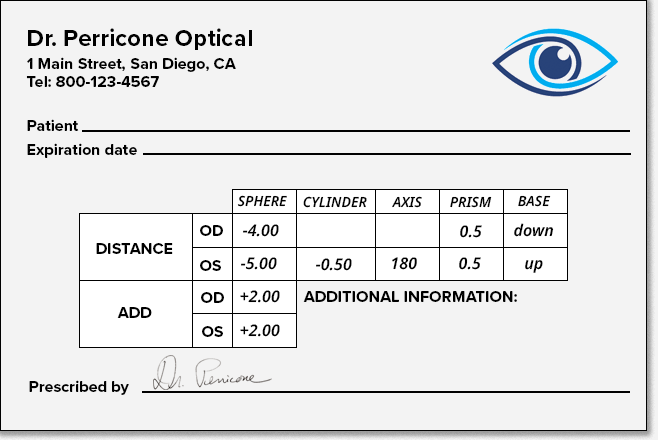
A prescription is normally written out by an optometrist like this:
R. -1.00/ -1.25 * 175
The first figure that you will see on an optometrists prescription is the SPHERE (abbreviated Sph). This is the main power of the prescription and represents myopia (shortsighted) when prefixed with a minus sign i.e -1.00, and hypermetropia (longsighted) when prefixed with a plus sign i.e +1.00. Often the Sphere power has a DS after it like this: +3.00DS. The "DS" signifies Dioptres Sphere, which is the unit of measurement for spectacle power.
The next figure you see is the CYLINDER power (abbreviated cyl). This represents the astigmatism in your prescription. Often this figure is shown like this -1.25cyl. Astigmatism is always along a certain angle (axis) from 0 to 180 degrees. i.e -1.00 * 175. Finally the sphere and cylinder power are usually separated by a slash ie sphere/cylinder * axis The R. signifies the right eye. (L. for the left)
A prescription for glasses forms the basis for a contact lens fitting. If you look at your prescription it will be in a format similar to one of these;
R. -3.00DS L. -3.50DS This indicates that you aremyopia (shortsighted) of moderate degree. Powers can range from -0.25DS to well in excess of -20.00DS. An average power for the myopic population would be about -3.00DS.
R. +3.00DS L. +3.50DS This indicates that you are hypermetropia (longsighted) of moderate degree. Powers can range from +0.25DS to well in excess of +20.00DS. An average power for the hypermetropic population would be about +3.00DS.
R -2.00/-1.00 * 35 L. -1.25/ -1.50 * 90 This prescription indicates that you are myopic, plus have a small amount of astigmatism. Astigmatism is best described as an irregularity in the shape of the cornea. The cornea is the clear covering on the front surface of the eye that helps the eye focus. An astigmatic cornea is often said to be shaped like a football. A normal cornea is round like a basketball. The different curvatures on the surface of the cornea cause the light entering the eye to focus at different points causing distorted vision. Astigmatism can affect one or both eyes, and is sometimes coupled with other visual impairments such as nearsightedness and farsightedness (see example below). This example shows a prescription that is shortsighted (the -2.00 part in the right eye), with astigmatism (the -1.00 part). In addition the final figure (35 in the case of the right eye) indicates the axis (angle) of the astigmatism. The axis (angle) can lie between 0 and 180 degrees and indicates the angle of the ovalness of the astigmatism. Low astigmatism would be below 1.00, moderate 1 to 3, and high above 3.
R. +2.50/ -1.00 * 180 L. +3.25 / -1.25 * 10 This prescription indicates that you are hypermetropic (longsighted), plus have a small amount of astigmatism
R +2.00/ -1.50 * 170 L. +2.50/ -175 * 180 Add +2.00 Sometimes the prescription will have an ADD power written after it, in particular if you are aged 45 or over. This indicates that you are presbyopic and need a additional power to help you read. You can have presbyopia in addition to any of the prescription above, or you may have only presbyopia and perfect vision otherwise.
Interchangeable?
A prescription for glasses is different than a prescription for contact lenses although they can be similar. A contact lens comes in direct contact with the cornea, which is the clear covering over the front surface of the eye. For this reason, there are additional measurements needed for fitting a contact lens and these need to be included in the prescription.
- the curvature of thecornea - the diameter of thecornea
Base Curve (BC) The curvature of the cornea is measured to determine the exact curvature (base curve) of the inside surface of the contact lens. This ensures the lens fits the shape of the eye providing optimum vision and comfort.
Diameter (D) The diameter of the cornea is measured and also necessary to find the optimal contact lens diameter. This measurement is fairly straight forward. A contact lens is usually 2 - 4mm larger than the diameter of the cornea.
The Same Only Different
A contact lens prescription can be the same as a prescription for glasses when:
- the prescription is a lower power, ie: -4.00 to +4.00 and
- there is absolutely no astigmatism present.
If you have any astigmatism or require a lens power greater than +/-4.00, the parameters of the contact lens can change.
- if you have astigmatism under 0.50, a spherical lens should be prescribed. - astigmatism of 0.50 to 0.75 can be effectively corrected with an aspheric lens. - astigmatism greater than 1.00 should be managed with a toric lens.
If your prescription power for glasses is greater than +/-4.00, you should see a difference in the power of your contact lens prescription. Generally, every time your glasses prescription increases or decreases by a power of 2, your contact lens prescription will increase by an additional power of +0.25. For every power change of 2 in a glasses prescription, the difference of +0.25 power is needed to compensate for the location of the contact lens. Your glasses are much further from the front surface of the cornea than contact lenses.
Essential Parts of Eyeglasses
The Eyeglass Rule requires that optometrists and ophthalmologists provide patients a copy of their prescription after the completion of an eye examinationwithout extra cost.
وبلاگ تخصصی عینک شامل مجموعه مطالب پزشکی است که اطلاعات مفیدی در رابطه با عینک , چشم، لنز، سلامتی چشم و راه های پیشگیری از بیماریهای چشمی، کنترل و درمان آن را در اختیار شما کاربر محترم می گزارد.



:max_bytes(150000):strip_icc():format(webp)/eyeglass-prescriptions-3421911-ADD-FINAL-26235ff7e7944a3cb3e4ff7cf933c8b5.png)
 وبلاگ تخصصی عینک شامل مجموعه مطالب پزشکی است که اطلاعات مفیدی در رابطه با عینک , چشم، لنز، سلامتی چشم و راه های پیشگیری از بیماریهای چشمی، کنترل و درمان آن را در اختیار شما کاربر محترم می گزارد.
