accommodation /ac·com·mo·da·tion/ (ah-kom″ah-da´shun) adjustment, especially of the eye for seeing objects at various distances.
Accommodation of the eye refers to the eye's ability to adjust its focus to see objects clearly at different distances. This is achieved by changing the shape and curvature of the eye's natural lens to bring images into sharp focus on the retina.
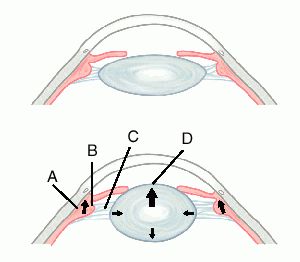
Changes during accommodation:
- (A), contraction of ciliary muscles
- (B), approximation of ciliary muscles to lens
- (C),relaxation of suspensory ligament
- (D), increased curvature of anterior surface of lens.
negative accommodation:
adjustment of the eye for long distances by relaxation of the ciliary muscles.
positive accommodation:
adjustment of the eye for short distances by contraction of the ciliary muscles.[1]
eRresearch by Navid Ajamin -- summer 2011

Light from a single point of a distant object and light from a single point of a near object can be seen clearly when the curvature of the lens changes.
What is the theory of accommodation?
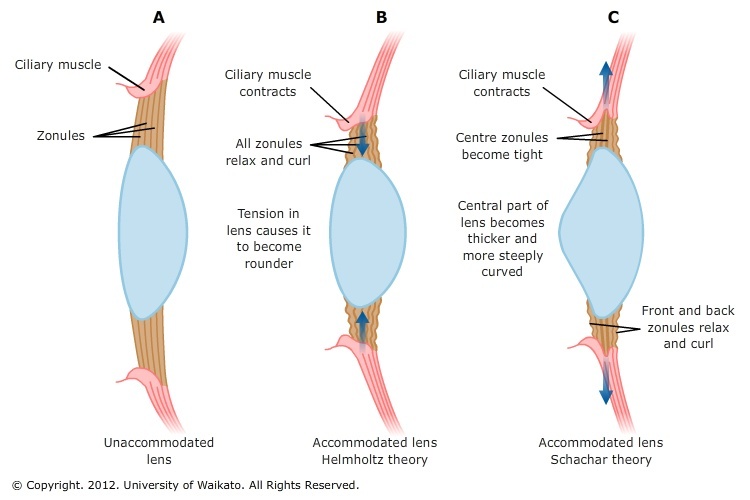
The Helmholtz accommodation theory is based on the assumption that the ciliary muscle diameter change during accommodation is responsible for the change in shape of the lens. During accommodation, the ciliary muscle contracts and thus the lens diameter is reduced.[12]

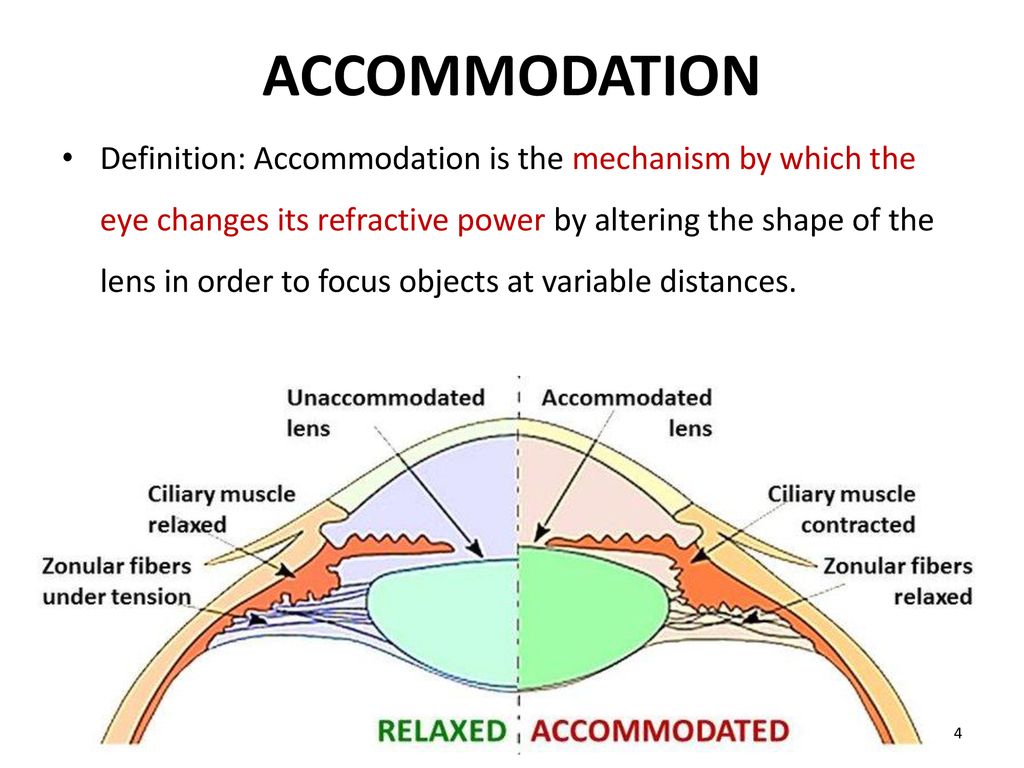
Schematic representation of the Helmholtz theory of accommodation, in which contraction of the ciliary muscle during accommodation (bottom) leads to relaxation of the zonular fibers. The reduced zonular tension allows the elastic capsule of the lens to contract, causing an increase in the anterior and posterior lens curvature.[13]
Accommodation is the process by which the eye increases optical power (the degree to which the lens converges or diverges light). This is necessary to produce a clear image (focus) on an object when it draws near the eye. The young human eye can change focus from distance to 7 cm from the eye in 350 milliseconds.[2]
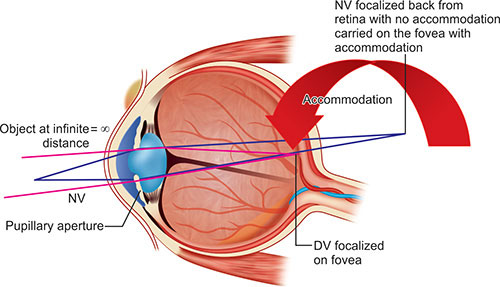
Eye accommodation is a physiological act of adjusting crystalline lens elements to alter the refractive power and bring objects that are nearer to the eye into clear sharp focus.
To focus on distant objects the ciliary muscles relaxes and make the eye lens thin. This increases the focal length of the eye lens and thus distance objects are seen clearly. But to focus on nearby objects the ciliary muscles contracts and make the eye lens thick. This decreases the focal length of the eye and which helps to see nearer objects clearly.
Aging makes the ciliary muscles losses in original strength as well as the crystalline lens losses its elasticity thus accommodation become difficult which end up in presbyopia (an age related vision problem).
Loss of accommodation is a normal process of ageing, called presbyopia. However, premature or acute accommodation loss in a child or young adult necessitates systemic evaluation and laboratory work-up to determine the aetiology. The most common cause of acute loss of accommodation is an unwanted drug effect.[6]
Eye accommodation decreases with age
Eye accommodation is good when the age is below 40 years, during this period the eye can be compared with an auto-focus camera (gets sharp pictures with varying object distance). After age 40, eye accommodation mechanism looses its ability and develops presbyopic eye, which can be compared with a fixed-focus camera (not able to get sharp pictures with varying object distance).[3]
The human eye accommodates by changing the shape of the crystalline lens. In the Lenses and images, we saw the relation
- 1/(object distance) + 1/(image distance) = 1/(focal length).
When the object distance changes, then either the image distance changes (as in the camera or the fish eye) or the focal length changes (as in the human eye).
Loss of accommodation and the use of reading glasses

As we age, our range of accommodation typically diminishes, either due to hardening of the lens or reduction in the muscles' ability to deform it, or both. The use of converging lenses in spectacles reduces the combined focal length.[11]
Types of Accommodation [4]
- Tonic accommodation: It is due to tonus of ciliary muscle and is active in absence of a stimulus. The resting state of accommodation is not at infinity but rather at an intermediate distance.
- Proximal accommodation: Is induced by the awareness of the nearness of a target. This is indepedent of the actual dioptric stimulus.
- Reflex accommodation: Is an automatic adjustment response to blur which is made to maintain a clear and sharp retinal image.
- Convergence-accommodation: Amount of accommodation stimulated or relaxed associated with convergence.The link between accommodation and convergence is known as accommodative convergence and is expressed clinically as AC/A ratio.
The accommodation reflex (or accommodation-convergence reflex) is a reflex action of the eye, in response to focusing on a near object, then looking at a distant object (and vice versa), comprising coordinated changes in vergence, lens shape (accommodation) and pupil size. It is dependent on cranial nerve II (afferent limb of reflex), superior centers (interneuron) and cranial nerve III (efferent limb of reflex). The change in the shape of the lens is controlled by the ciliary muscles inside the eye. Changes in contraction of the ciliary muscles alter the focal distance of the eye, causing nearer or farther images to come into focus on the retina; this process is known as accommodation.
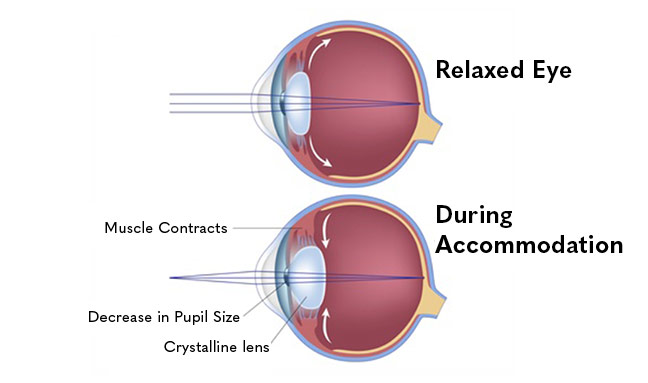
The reflex, controlled by the parasympathetic nervous system, involves three responses:
pupil constriction, lens accommodation, and convergence.
A near object (for example, a computer screen) appears large in the field of vision, and the eye receives light from wide angles. When moving focus from a distant to a near object, the eyes converge. The ciliary muscle constricts making the lens thicker, shortening its focal length. The pupil constricts in order to prevent strongly diverging light rays hitting the periphery of the cornea and the lens from entering the eye and creating a blurred image.
Focus on near objects
The refractive index of the eye’s lens system allows the eye to produce sharply focused images. For example, geometrical optics show that as a distant object is brought closer to the eye, the focus of the object becomes blurrier in the plane behind the retina; however, as a result of the increase in the refractive power of the eye, this image becomes clear. The refractive power mainly resides in the cornea, but the changes in refractive power of the eye is achieved by the lens changing its shape.
In order to fixate on a near object, the ciliary muscle contracts around the lens to decrease its size. The suspensory zonules of Zinn relax and the radial tension around the lens is released. This causes the lens to form a more spherical shape achieving a higher level of refractive power.
Focus on distant objects
When the eye focuses on distant objects, the lens holds itself in a flattened shape due to traction from the suspensory ligaments. Ligaments pull the edges of the elastic lens capsule towards the surrounding ciliary body and by opposing the internal pressure within the elastic lens, keep it relatively flattened.
Opposite of fixating on a near object, the ciliary muscle relaxes and the diameter of the lens increases to increase the lens’ size. The tension along the suspensory ligaments is increased to flatten the lens and decrease the curvature and achieve a lower refractive power.[7]
Accommodation reflex
The accommodation reflex (or near response) is a three-part reflex that brings near objects into focus through lens thickening, pupillary constriction, and inward rotation of the eyes—eye convergence.
The accommodation reflex is an adjustment of the eye for near vision.
Three phenomena are involved:
- Increased convexity of the lens. The suspensory ligament of the lens inserts peripherally into it. At rest, the ligament maintains tension on the periphery of the lens, such that it remains flat. During the process of accommodation the parasympathetic neurons of the Edinger–Westphal nucleus govern the contraction of the ciliary muscle, which relaxes some of the tension on the ligament, modifying the shape of the lens.
- Pupillary constriction. Parasympathetic fibers convey the impulse for the contraction of the sphincter pupillae. The pupil constricts and thereby increases the depth of focus.
- Convergence of the eyes. The oculomotor nuclei send the impulses for contraction of both medial rectus muscles, causing the eyes to converge.[10]

Reference:
- medical-dictionary.thefreedictionary.com/accommodation
- simple.wikipedia.org/wiki/Accommodation_(eye)
- healthy-ojas.com/eye/presbyopia.html
- slideshare.net Rohit Rao, Consultant ophthalmologist theories and anomalies of accommodation
- researchgate.net/figure/Mean-add-power-and-amplitude-of-accommodation-for-age-and-gender_tbl1_258995127
- ncbi.nlm.nih.gov/pmc/articles/PMC5291063
- en.wikipedia.org/wiki/Accommodation_reflex
- sageglass.com/industry-insights/why-views-are-beneficial-our-visual-health
- accuvision.co.uk/glossary/accommodation
- sciencedirect.com/topics/neuroscience/accommodation-reflex
- animations.physics.unsw.edu.au/jw/light/eye-optics-anatomy-accommodation.htm
- sciencedirect.com/science/article/pii/S0042698905003354
- aao.org/education/image/helmholtz-theory-of-accommodation
 وبلاگ تخصصی عینک شامل مجموعه مطالب پزشکی است که اطلاعات مفیدی در رابطه با عینک , چشم، لنز، سلامتی چشم و راه های پیشگیری از بیماریهای چشمی، کنترل و درمان آن را در اختیار شما کاربر محترم می گزارد.
